28 March 2010

Souls Refreshed in Seoul

We just returned from the most delightful weekend trip visiting friends, Kurt and his wife J.Sun, in the soul (Yongsan) of Seoul. We made the trip on the KTX bullet train that speeds cross-country in less than two hours.  Here are a few photo's from our travels.
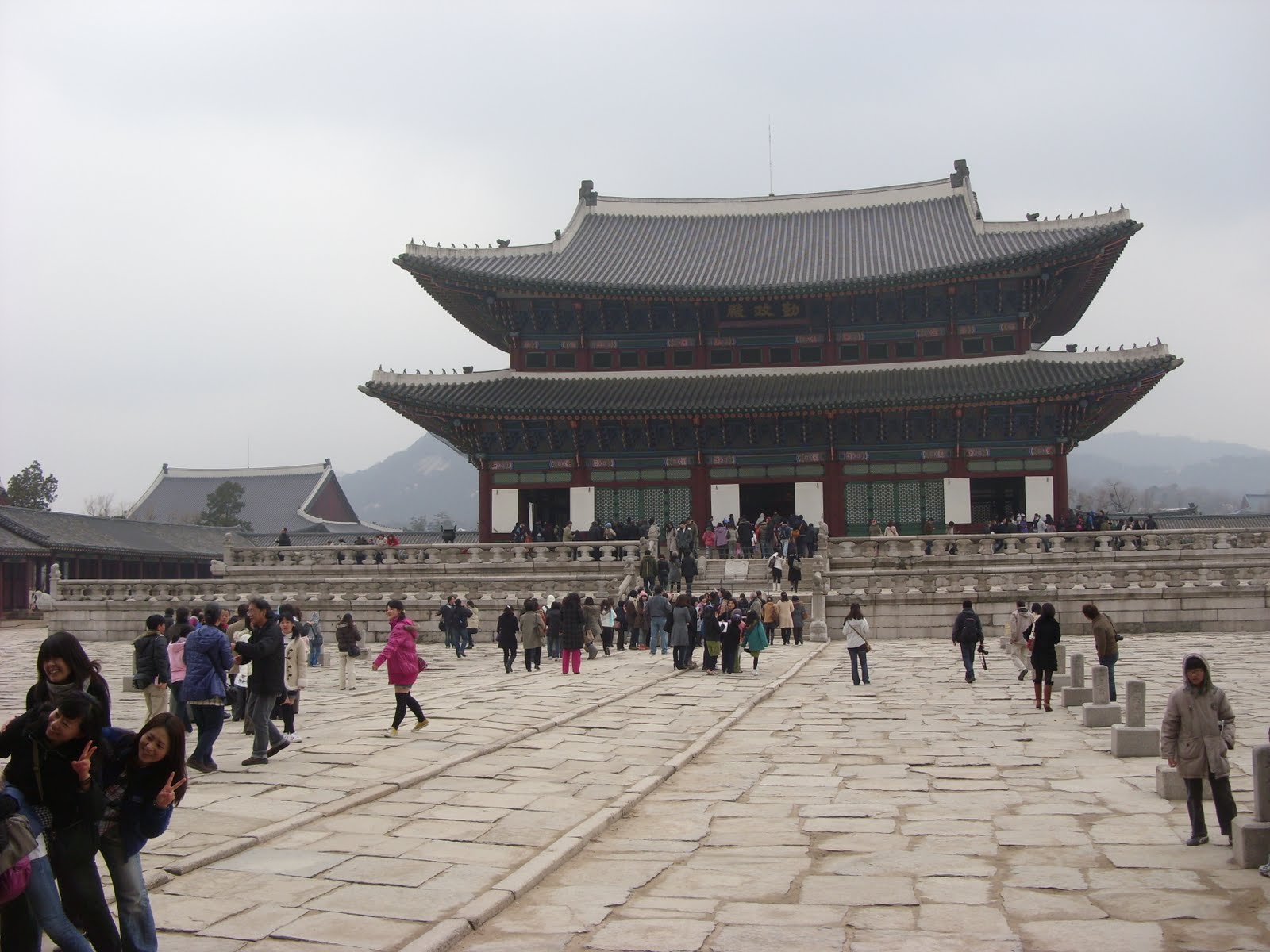
Geunjeongjeon at Gyeongbokgung Palace

A Gapsa Guard protecting the Palace Gate

The King's Throne in Geunjeongjeon

On the steps in front of Jibokjae (a reception hall for foreign envoys).

A study within Cheonchujeon next to Sajeongjeon -- "Hall where the king should thnk deeply before deciding what is right or wrong."
Mr. Park, a gentleman who volunteered to serve as our guide throughout the grounds of Gyeongbokgung.

Changing of the Gate Guard Ceremony

The viewof Seoul from Kurt & J.Sun's apartment on the 22nd floor of their building.

J.Sun, Sandy and Kurt in the gardens outside the Dragon Hill Lodge on Yongsan Base. Kurt is a Captain in the U.S. Army and the son of good friends from back in St. Louis.
Korean War Memorial Museum

Sunday afternoon shopping along the streets in the heart of Seoul.

23 March 2010

A Sunny Day at Sunrise Park

We hesitated to step out of our apartment Saturday morning.  It was too good to be true.  The morning skies looked sunny. The temperature might actually have risen. After just a bit of hesitation, we ventured out. Our weak faith in Pohang's March weather was strengthened!  Yes!  Yes!  It is truly warm. There's not a trace of clouds in the sky. Those are birds we hear singing out their calls.  That is a fragrance of cherry blossoms in the air!  Let's pack a picnic and head out to the bus stop.  We're on our way to the park!

For those of you who know St. Louis, you know that Forest Park is the crown jewel of the many public parks spread throughout both city and county.  For Pohang, Sunrise Park is their Forest Park. It is situated on the eastern side of the city along the natural bay that makes Pohang one of the principal port cities of Korea.  A short 15-minute bus ride from Handong's campus brings us to the southeastern entrance of Sunrise Park.
Across the street from the park rises a series of apartment towers forming one of the many typical housings complexes found throughout the city of Pohang. If you visit nearly any sizeable city in Korea, you will see similar apartment buildings. There are countless numbers of them.
Under a beautiful blue sky, we enjoyed a wonderful walk up the hillsides and through the park's gardens with their lovely arrangements of enormous granite rocks, both hardwood and fruit trees as well as shrubberies and flowers.  The trees are just starting to bud and the flowers are almost in bloom.  The warm sunshine and the calm sea breezes made for delightful temperatures through the morning and into the early afternoon.
Sandy and I enjoyed our picnic lunch on the steps of the amphitheater that overlooks the sea, and then, having been recharged, we ventured back along the trials up and over the hills toward the new museum of steelworks that will shortly be opening. (Did I mention in previous posts that Pohang is the steel capital of Korea?  Pohang is to Korea what Pittsburg is to the U.S. and what Sheffield and Birmingham are to England.)
After a quick bit of shopping at the local Lee Plus (like your neighborhood Walgreens without the pharmacy), we hopped on the next Handong bus back to campus and enjoyed a well-earned late afternoon nap.  Our delightful day at Sunrise Park convinced us that Pohang truly is a sunny place!

18 March 2010

How Do You Bear It???

I frequently hear this question from both students and fellow faculty members alike when I inform them that Sandy and I are living in a studio apartment within the campus Mission House. Their questions reflect the common knowledge that the Mission House studio apartments were originally designed for short-term occupancy by a single individual -- not extended living for a couple. How do you bear living in such close-quarters?

I also hear the same question -- So, how do you bear it? -- from friends and family, when they ask about our adjusting to life in a culture that is in so many ways "upside-down" from what a modern American is use to in this day and age. Not that we are experiencing "primitive living" in any way, shape or form -- our son Caleb would quickly attest to the many "modern" conveniences (like electric power and gas heat) that we daily are dependent upon -- but many of the "customary" life practices here leave us feeling very "foreign."

One experience this past week brought this question to mind in a particular manner. I was invited as a member of the undergraduate law faculty to attend the law student association's "MT" -- "membership training" session. I was informed that a bus would be provided to transport everyone from campus to a dining facility off-campus where we would enjoy a meal followed by the MT session. The bus was to depart campus at 6:30pm on Friday and, I was told, would not return until 2am.

What did you just say? 2am? I heard correctly, for such are the "bonding" experiences of students here -- which, if I think about it for a few minutes, is not unlike the late night excursions of university students in the States or in whatever country, for that matter -- but, did they really want their professors to hang-out with them? Well, . . . yeah. I was even treated to a seven course meal, prepared by the leaders of the student association, no less.

And then, we were all directed to a fellowship hall on a lower level of the building where a worship service was held. Prof. Chi, the chairman of the School of Law, presented a challenging message from the story of Micaiah, the prophet who spoke truth to power even though all the other 400 prophets affirmed the evil King Ahab’s plan. He reminded us that “bearing witness to the truth” in our efforts to “do justice” may often prove costly in our careers and even to our lives.

I was reminded by Prof. Chi’s words of what Jesus had said to his disciples: “For truly, I say to you, whoever gives you a cup of water to drink because you bear the name of Christ, will by no means lose his reward.” (Mark 9:41, emphasis added). Now the question came to me in a much different way – How do you bear it? That is, how do I bear the name of Christ? Do I bear it well, or do I bear it poorly?

That I “bear it” at all is only by the gift of God’s abundant grace. But, I would do well to examine myself regularly with this question. If I claim to be a Christ-follower, how am I doing bearing his name? Interestingly, the first followers of The Way (Acts 9:2) did not take on the name “Christian” (literally “little Christ’s”). Rather, they were called Christians in the town of Antioch. (Acts 11:26) Others recognized that they were following the life and teachings of Jesus Christ and so called them by his name. Is that how I have come to bear his name?

How am I bearing it, today?

ps – I didn’t end-up staying at the MT until 2am. One of my good and faithful colleagues, Prof. Cheoljoon Chang, graciously offered me a ride back to campus around 11pm. I have already found that when one has to bear with sleeplessness, it is an even greater challenge to bear the name. The spirit is indeed willing, but the flesh is weak.

11 March 2010

Welcome to Sunny Pohang!

Well . . .  that's at least what all the folks around here had told us we would be enjoying by this time in March -- lots of sunshine and increasingly warmer temperatures.  So, it came as quite a surprise last evening when I learned that there was snow in the forecast again.  When we arrived nearly a month ago now, the eastern part of Korea (where we are located) had just been blanketed with about 5 inches of snow -- more than they had received in the last 20 years, we were told.  It never snows like this in Pohang!  It was a fluke, not global climate change.
Right! So, if it should snow again, it would only be a dusting.  You can imagine our reaction, then, when we opened the door to our apartment Wednesday morning and found that nearly 6 inches of snow had fallen in the night and it was still coming down, and I mean coming down like a blizzard!  A second record-setting snow in Pohang.  Sandy was undaunted!  Being the industrious person she is, she immediately said, "If we can't take our walk this morning, then we need to find a shovel!"

So, off I went to the Student Union (that's the building at the end of the street in the photo above).  There's a construction project underway to expand the SU, and just under that big canopy I found a large pile of sand into which was stuck a flat-bladed shovel. I trudged back through the new fallen snow and presented my find. Sandy promptly took the shovel and began clearing a path from our front door all the way along the walkway in front of the Mission House to the point at the end where the walkway meets the street.
In no time at all, Sandy had completed the task of removing several inches of snow from our building's front walk.  But, was she finished? No way! If you even began to think that she was satisfied with only shoveling the walkway, you don't know my wife very well at all.  Having cleared off our neighbors sidewalks, she then proceeded to shovel the stairway that leads to the apartments on the second floor of the Mission House.  Now, did I tell you that we were doing all this shoveling at 6:30 in the morning? 
By 7am, we had completed clearing all the snow in front of the Mission House and on the stairwell!  What a warm welcome we've been experiencing here in Sunny Pohang!  The lack of sunshine, though, hasn't put a damper on Sandy's readiness to get a job done when she sees a need! 
 
And, I'm happy to report, all that snow has nearly melted away in two days.  In fact, I spotted a cherry tree in blossom on my walk over to All Nations Hall this morning!  The sure signs of Spring have begun to show themselves. So, we're looking forward to some soon coming sunny days here in Pohang.

09 March 2010

Lifelong Learning in Balance

Balance is one of the essential keys to living wholly. The Greeks taught moderation in all things -- the golden mean. The Scriptures, too, teach balance -- particularly in the arena of study. On the one hand, Paul exhorts Timothy to "study to show himself approved unto God as servant of the truth who is able to "cut a straight line" with God's Word. (See 2 Timothy 2:15). On the other hand, though, Solomon warns us that "there is no end" to the "making of many books," and "much study is weariness to the flesh." (Ecclesiastes 12:12).

Hence, balance is also the key to study. When, however, you live on a university campus just a short walk from your office and two libraries, not to mention having ready access in both home and office, via the Internet, to a wide array of library collections from institutions of higher learning around the world, you are daily confronted with the temptation to live an unbalanced life -- to engage in "much study" and aspire to the "making of many books." A life lived according to the golden mean easily escapes you.

A life of balance can be an even greater challenge, though, in the face of requests for your assistance with the learning of others. In the past week, I have been approached by three different people asking for my help with the forming and leading of study groups (both a law student group and a faculty group) and the mentoring of other faculty. My first inclination is to offer whatever help I may be able to give. Jesus’ words, “Freely you have received, freely give” come to mind. I want to encourage others in their desire to learn and grow in knowledge as well as in faith.

So what’s a person, who believes they have been called to teach, to do? The Chinese proverb written along the side of this post says: “Study is eternal.” That is, the pursuit of truth, insight and understanding is a lifelong endeavor. Each day we’re on the path of learning. Our progress along the way, though, will be substantially enhanced by keeping our life, as a whole, in balance. Even as we seek to respond to the requests and inquiries of others, we must maintain a balance in our life together of learning.

Bonhoeffer suggests in Life Together that one of the key means of maintaining balance in life is to live each day as both a day with others and as a day alone. Indeed, he emphasizes how these two aspects of life impact each other when he writes, “Let him who cannot be alone fear to be in community; and, let him who cannot be in community, fear to be alone.” In order to respond effectively to others, I must maintain a daily discipline of solitude. So too, study is balanced with work, rest, and prayer.

These are the rhythms to the balance of  a long life of learning.

06 March 2010

Go With Him Two . . .

On Friday mornings, after my Legal Argumentation class and office hours, I attend Prof. Enlow's "Christianity and Law" lectures at HILS. (Handong International Law School -- the graduate law school that is now located on the first two floors of All Nations Hall below my department -- the University's undergraduate School of Law housed on All Nations' third floor).  Yesterday's lecture focused upon the 2nd Century Letter to Diognetus written by an anonymous Christian who had been taught by the Apostles (most likely Paul).

The recipient of this letter, Diognetus, is considered by many scholars to have been the Diognetus who was the teacher of Emperor Marcus Aurelius (that's the emperor above; no known bust of Diognetus exists).  Diognetus, though, was a well-known philosopher of his day and may have looked a bit like this simply-clothed fellow striking a pensive pose with scroll in hand.

It is a very interesting letter seeing as it describes how followers of Christ, some 1800 years ago, lived their lives in the midst of the Roman culture of their day.  One passage from the letter to Diognetus was particularly arresting:

For Christians cannot be distinguished from the rest of the human race by country or language or customs. They do not live in cities of their own; they do not use a peculiar form of speech; they do not follow an eccentric manner of life. This doctrine of theirs has not been discovered by the ingenuity or deep thought of inquisitive men, nor do they put forward a merely human teaching, as some people do.

Yet, although they live in Greek and barbarian cities alike, as each man's lot has been cast, and follow the customs of the country in clothing and food and other matters of daily living, at the same time they give proof of the remarkable and admittedly extraordinary constitution of their own commonwealth.

They live in their own countries, but only as aliens. They have a share in everything as citizens, and endure everything as foreigners. Every foreign land is their fatherland, and yet for them every fatherland is a foreign land. They marry, like everyone else, and they beget children, but they do not cast out their offspring.

They share their board with each other, but not their marriage bed. It is true that they are "in the flesh," but they do not live "according to the flesh. They busy themselves on earth, but their citizenship is in heaven. They obey the established laws, but in their own lives they go far beyond what the laws require.

I found that last line to be especially telling.  Could the same be said of Christ's followers today?  Could it be said of me here at Handong?  Do I make it a practice of my life to "go far beyond" what is required of me?  As a disciple of Christ do I follow his teachings in the Sermon on the Mount?  When I am compelled to go one mile, do I willingly "go with him two"?

And if anyone would sue you and take your tunic, let him have your cloak as well.  And if anyone forces you to go one mile, go with him two miles.  Give to the one who begs from you, and do not refuse the one who would borrow from you.  ~ Matthew 5:40-42

02 March 2010

First Day's Daunting

The first day of the new term can be daunting. When you look at your first class roster and see more names than the number of seats in the classroom you've been assigned, you can feel a bit overwhelmed. But, with the help of your able Teaching Assistant, you scout out available, larger classrooms down the hall and find, to your great relief, that the largest lecture room in the new wing of your building is open and accommodates all of the students who have registered for your course -- even the ones on the waiting list who are making heart-felt appeals for admission.

As the room begins to fill, you are pleased to see that you actually recognize some of the students as those who had taken (and survived) one of your classes in the past fall term.  You think to yourself, "Maybe this term I'll even be able to master some of their names." Then, it happens.  More students arrive.  Now there are students who are on neither the class roster nor the waiting list!  That daunting feeling begins to creep up on you again.  As the seats begin to fill, the students are thankful that you have selected the largest classroom, but you begin to suspect that a more moderate-sized one might have been a better choice.

The time comes to begin your introduction and overview of the course, and after a few words of personal greeting, you invite each of the students to introduce himself and herself.  As each rises to do so, up and down through all of the many rows, you realize once again why you do what you do.  Each face is full of expression.  Each voice speaks with its own accent -- Korean, both South and North, Vietnamese, Tajik and Mongolian as well as a few Korean Americans who grew up in Minnesota, New Jersey or California, and even other Koreans who have lived in South Africa and Senegal.  You have been given the opportunity of leading and the privilege of learning together with some of the best and brightest students from around the world.

While the day began under daunting circumstances, by the end of the first class period that overwhelming feeling has transformed into an enveloping excitement.  The new term has begun.  Its time to seize the day, and undertake another journey with your students as together you continue to pose and ponder the persistent questions of life.

Test everything; hold fast what is good. ~ 1 Thessalonians 5:21