
Although this is the first Thanksgiving I have ever experienced apart from my family, I've been sustained by the fellowship of new friends, and I've been reminded of the blessings that are bestowed upon us through our brothers and sisters in the body of Christ.
I'm also thankful for the blessing of internet technology that enabled me to enjoy a video call with my family who had gathered at my mother's home for a traditional Thanksgiving feast.
In spite of the fact that I'm half-a-world away from the people I love the most, I was enabled to give thanks this year in ways more meaningful to me than ever before.
Give thanks to the Lord, for he is good,
for his steadfast love endures forever.
It is he who remembered us in our low estate,
for his steadfast love endures forever;
and rescued us from our foes,
for his steadfast love endures forever;
he who gives food to all flesh,
for his steadfast love endures forever.
Give thanks to the God of heaven,
for his steadfast love endures forever.
Psalm 136:1,23-26
27 November 2009


26 November 2009
He Who Would Be Great, Must Be . . .
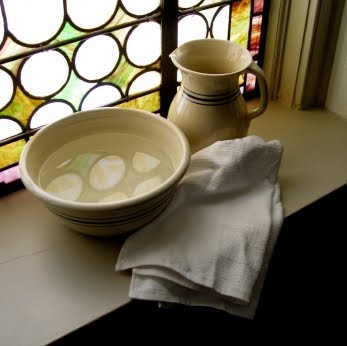
This realization came home to me a couple of evenings ago when I decided to head over to Hyoam Restaurant -- the best place to eat on campus -- for my dinner. It's a popular spot among both students and faculty. When I arrived, the line was quite long, so I took up my place at the end and waited. The special on Tuesday evenings is breaded pork tenderloin. It tends to be one of the hottest sellers. As I waited for the line to progress toward the front counter where orders are placed, I was hoping (okay, I was also praying) that there would be at least one pork tenderloin left.
When I had made it about half-way up to the counter, I noticed that someone was quickly moving up the line, passing by me and going straight to the front. Hold-on a second! I've been waiting in this line for nearly 10 minutes, patiently taking gradual steps along the way as I watched more and more people ahead of me walk away with their trays filled with the pork tenderloin special. Who was this guy cutting-in line? Only later did I learn (after the special sold-out and I ended up with the "not-so teriyaki" chicken) that he was a faculty member. Evidently, the custom on campus allows faculty members to go to the head of the line. They need not wait their turn with everyone else. That's the local practice.
I thought about that for a while. I had every right in this culture to go straight to the front of the line, and no one would object. But then, I reflected. What would be better for a teacher to do? One who is attempting to teach in the classroom about living like a follower of Christ in every dimension life? Would it be better to prefer myself or to defer and wait my turn in line like all the students? So now, I run the risk of acting in a manner not expected of faculty on this campus if I simply wait my turn in line for a meal. I'm finding, though, that being "counter-cultural" is our calling when it comes to the commands of Christ.
Jesus took time on the night he was betrayed not only to share a last supper with his disciples, but also to wash their feet. He calls us to follow him -- to love others just as he has loved us -- to take up the basin and the towel.
Love one another with brotherly affection. Outdo one another in showing honor. Do not be slothful in zeal, be fervent in spirit, serve the Lord. ~ Romans 12:10-11.
23 November 2009
"I passed along and observed the objects of your worship . . ."

Every culture, every place has objects of worship. For Korea, Buddhism has had a substantial impact upon the formation of its culture. This past Saturday, I was invited to travel to Gyeongju, the ancient capital city of Korea, and to tour Bulguksa Temple by my good friend and young brother, Kris and his wife Mary, who is a 3d year law student soon to graduate from Handong International Law School. In many ways, Gyeongju is the Athens of Korea. As we stepped through Bulguksa's gates, we began to realize that we were entering a very special place.
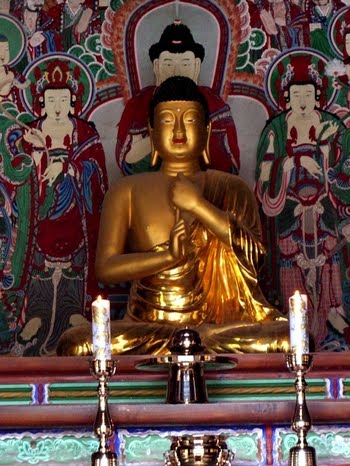
We met one elderly Korean lady who serves within the temple (most likely an "Anna" of this temple) and, though, we could not communicate with her in words, she was drawn to Kris and Mary's little 18 month-old daughter, Sadie Rose. She displayed the warmth and tenderness of a grand mother, and her face glowed when Sadie Rose gave her a smile.
I wonder if what I sensed as we made our way around the temple and its cloister walk was something like what Paul experienced as he perused the Athenian altars. Just as the Apostle heard echoes of God's truth in the words of the Greek poets and philosophers (see Acts 17:26-28), I perceived the wisdom of the ages in several decorative scrolls upon which monks from the temple had written some sayings of the Buddha.
One read, "Go on your way with one mind." It prompted me to think of the admonition in James 1 to single-minded devotion to Christ. Another said, "The fragrance of a flower may last for 1,000 miles, but the aroma of a virtuous life will endure for 10,000 years." That one reminded me of Paul's description of followers of Jesus as an "aroma of Christ" in 2 Corinthians 2. Kris and I talked as we walked about the ways we can see God's common grace reaching out and speaking to and through diverse cultures.

It takes time to "observe the objects of worship" in other cultures. I'm sure Paul spent several days walking about Athens before he found the altar to the "Unknown God." That altar became his entree to conversation with the people who spent there days hanging out on Mars Hills discussing the latest ideas of the day. I don't think I'll encounter any Stoics or Epicureans around these parts, but maybe a deeper appreciation of the sayings of the Buddha may equip me to engage one of his followers who are without a doubt are -- like those in the Athens of Paul's day -- a very religious people.
*****************
Here are a few more pictures that Kris took while on our tour through Bulguksa.

The monastery's prayer bell (barrel-shaped copper bell in the center of this structure.

Close-up of the prayer bell. Note the red, log-sized striker suspended to the right side of the bell.

Mary, Kris and Sadie Rose all bundled-up (It was a bit chilly)

A strange American chap we found posing in front of the Temple.
20 November 2009
Things We Leave Behind
Discipleship is marked to some measure by things we leave behind. This was clearly true of Jesus' first disciples who left their nets as they responded to his call, "Follow me." A few weeks ago, I engaged in an email correspondence with a good friend and brother on this very subject. The topic has commanded my attention for the better part of the past ten years. I believe, though, that I am just now beginning to be able to articulate what is meant by following Jesus.
Here is a portion of what I wrote: "I have found that the actions that bear witness to true faith and hope are most often actions of the believer giving up, in very practical ways, his life ambitions, possessions, aspirations and desires, and then going where Christ both calls and leads him. So, the more pressing questions of personal examination for me, for you, for any follower of Christ who desires to follow Him in more authentic ways in the here and now, are: What have I given up? Where have I gone? What am I willing to give up? Where am I willing to go?"
"When a person genuinely examines himself/herself with such questions, I would venture to say that for the larger part of the professing church, the answers to what have I given up is very little or nothing, and to where have I gone is for the most part no where. I am thankful that I see in many young people, who today are challenged by the reality of authentic faith and hope, a true willingness and obedience to give up and to go. For in a very real sense, if the answer to the questions of willingness are not "everything" and "anywhere" then we have not truly appreciated what Christ has done for us nor have we begun to enter into what He will do through us."
After being here at Handong, though, for the past three months (today marks my 90th day away), I cannot say that I am following Jesus any closer because the authenticity of following is not measured by distance from the things, places or even the people we've left behind. Rather, I believe it can only be evaluated in terms of the nearness of my heart's desire to the person of Christ and the measure to which my volition is filled by the will of God. That desire will often move us to leave things behind, to depart from places of security and to separate, for a time, from even the people that we love more than any other people on earth.
Is this then where we truly find freedom? The kind of freedom Jesus was talking about when he said, "If the Son sets you free, you will be free indeed"? I think it is very much what the Apostle Paul wrote to the Galatians Christians about when he said, "You have been called unto freedom, but do not use your freedom as an occasion for the flesh (i.e. "self-advancement" or "self-gratification"), but by love serve one another. Service of others in the love of Christ will often -- may I say always -- lead us to leave things of our own behind. But it may also call us to depart the familiar places and to separate from people dearly loved.
The problem is, leaving behind, departing and separating are not easy things to do. They don't inspire confidence in our decisions nor a greater sense of commitment to even the noblest cause that may have motivated our actions. Instead, we are often submerged into doubt, but these are the times when we look back not just at what has brought to the place we now find ourselves to be, but also to the paths that others have chosen in their desire to know and do the will of God. In the testimonies of others who have trod upon such pilgrim paths, we find hope and a renewing of our faith in the one whom we follow.
We do not walk our journey alone. To follow means we are always walking after another -- the one who has promised to never leave or forsake us. So may I, may you find freedom in the things we leave behind.
Truly, truly, I say to you, when you were young, you used to dress yourself and walk wherever you wanted, but when you are old, you will stretch out your hands, and another will dress you and carry you where you do not want to go.” (This he said to show by what kind of death he was to glorify God.) And after saying this he said to him, “Follow me.” ~ John 21:18-19
Here is a portion of what I wrote: "I have found that the actions that bear witness to true faith and hope are most often actions of the believer giving up, in very practical ways, his life ambitions, possessions, aspirations and desires, and then going where Christ both calls and leads him. So, the more pressing questions of personal examination for me, for you, for any follower of Christ who desires to follow Him in more authentic ways in the here and now, are: What have I given up? Where have I gone? What am I willing to give up? Where am I willing to go?"
"When a person genuinely examines himself/herself with such questions, I would venture to say that for the larger part of the professing church, the answers to what have I given up is very little or nothing, and to where have I gone is for the most part no where. I am thankful that I see in many young people, who today are challenged by the reality of authentic faith and hope, a true willingness and obedience to give up and to go. For in a very real sense, if the answer to the questions of willingness are not "everything" and "anywhere" then we have not truly appreciated what Christ has done for us nor have we begun to enter into what He will do through us."
After being here at Handong, though, for the past three months (today marks my 90th day away), I cannot say that I am following Jesus any closer because the authenticity of following is not measured by distance from the things, places or even the people we've left behind. Rather, I believe it can only be evaluated in terms of the nearness of my heart's desire to the person of Christ and the measure to which my volition is filled by the will of God. That desire will often move us to leave things behind, to depart from places of security and to separate, for a time, from even the people that we love more than any other people on earth.
Is this then where we truly find freedom? The kind of freedom Jesus was talking about when he said, "If the Son sets you free, you will be free indeed"? I think it is very much what the Apostle Paul wrote to the Galatians Christians about when he said, "You have been called unto freedom, but do not use your freedom as an occasion for the flesh (i.e. "self-advancement" or "self-gratification"), but by love serve one another. Service of others in the love of Christ will often -- may I say always -- lead us to leave things of our own behind. But it may also call us to depart the familiar places and to separate from people dearly loved.
The problem is, leaving behind, departing and separating are not easy things to do. They don't inspire confidence in our decisions nor a greater sense of commitment to even the noblest cause that may have motivated our actions. Instead, we are often submerged into doubt, but these are the times when we look back not just at what has brought to the place we now find ourselves to be, but also to the paths that others have chosen in their desire to know and do the will of God. In the testimonies of others who have trod upon such pilgrim paths, we find hope and a renewing of our faith in the one whom we follow.
We do not walk our journey alone. To follow means we are always walking after another -- the one who has promised to never leave or forsake us. So may I, may you find freedom in the things we leave behind.
Truly, truly, I say to you, when you were young, you used to dress yourself and walk wherever you wanted, but when you are old, you will stretch out your hands, and another will dress you and carry you where you do not want to go.” (This he said to show by what kind of death he was to glorify God.) And after saying this he said to him, “Follow me.” ~ John 21:18-19
19 November 2009
Eating for Pleasure or for Wholeness?
Three of my Korean colleagues took me out for dinner last evening. They assured me that it would be a special treat. The night was cold and blustery. The meal I was promised was especially suited, I was told, to warm chilled bones. The restaurant where we arrived specialized in a traditional Korean "stew." So we sat, traditional Asian-style, cross-leged around a table that rose about 15 inches from the floor.
Upon its presentation, the "stew" appeared to be something like a spinach soup. There was a thick body of greens, yet the broth had more than a hint of a seafood flavor. I was later told that the base of the broth was a collection of very small shell fish. My colleagues consumed their bowls of stew with only momentary pauses for conversation. I, on the other hand, was talking more and eating less.
Without a doubt, the substance of the stew was quite healthy and hearty. I'm sure that I would have benefitted greatly had I been able to consume more of it. What I found difficult, though, was convincing my taste buds of this truth. It became quite self-evident to me that as a Westerner I have the habit of eating, first and foremost, to please my tongue rather than to fortify my body as a whole.
I was, however, able to take a few spoonfuls of rice, submerging them gently into the broth for a moment, and then swallowing quickly before any distinctly Korean flavors had much of an opportunity to stimulate my gustatory faculties. I ingested a small portion of the stew, but I definitely did not savor its flavor.
So, what's this poor American, bound by the habit of eating for pleasure, to do? I ate as much as I could, and then confessed to my brothers that I still have much to learn from them who eat first for the benefit of their whole bodies' health and who have taught their taste buds to appreciate nourishing foods much higher than tantalizing treats.
Maybe, that would actually be a very useful approach to all our forms of consumption -- whether it be the food and drink we take-in through our mouths or the images and ideas we "consume" with our eyes and ears. Clearly, Eastern habits of life have much more to teach me.
Upon its presentation, the "stew" appeared to be something like a spinach soup. There was a thick body of greens, yet the broth had more than a hint of a seafood flavor. I was later told that the base of the broth was a collection of very small shell fish. My colleagues consumed their bowls of stew with only momentary pauses for conversation. I, on the other hand, was talking more and eating less.
Without a doubt, the substance of the stew was quite healthy and hearty. I'm sure that I would have benefitted greatly had I been able to consume more of it. What I found difficult, though, was convincing my taste buds of this truth. It became quite self-evident to me that as a Westerner I have the habit of eating, first and foremost, to please my tongue rather than to fortify my body as a whole.
I was, however, able to take a few spoonfuls of rice, submerging them gently into the broth for a moment, and then swallowing quickly before any distinctly Korean flavors had much of an opportunity to stimulate my gustatory faculties. I ingested a small portion of the stew, but I definitely did not savor its flavor.
So, what's this poor American, bound by the habit of eating for pleasure, to do? I ate as much as I could, and then confessed to my brothers that I still have much to learn from them who eat first for the benefit of their whole bodies' health and who have taught their taste buds to appreciate nourishing foods much higher than tantalizing treats.
Maybe, that would actually be a very useful approach to all our forms of consumption -- whether it be the food and drink we take-in through our mouths or the images and ideas we "consume" with our eyes and ears. Clearly, Eastern habits of life have much more to teach me.
17 November 2009
"Make This Your Occupation . . . "
"What should my second major be?" This was the question posed by a young man who stopped by my faculty office Monday morning. He is a freshman and a student in my Survey of American Law course. Every student here at Handong is expected to have two majors. Both are to be chosen by the student.
My young visitor had already chosen his first major -- U.S. & International Law -- the program of study that I was invited to teach. Now, he was trying to determine his second major. Should it be Informational Technology -- an area in which he has a keen interest; should it be Management & Economics or something else?
How do you go about answering such questions? Some might suggest the "standard" answers: choose a major that will give you a "fall-back" position should your aspirations for law school prove beyond your abilities to achieve. Or, choose a major that will provide you good job opportunities when you graduate.
I found myself, though, in a very perplexing spot. I wanted to be helpful and encouraging to my young student. But, I did not want to just give him the "quick answer" he was looking for. Rather, I wanted to challenge and guide him to think for himself.
You see, I'm beginning to learn that most Korean students (and Asian students, in general, for that matter) look to their elders, their professors, their pastors for specific answers. They want to be told what to do; what to think. It is especially true, it appears, in Korea because of the cultural influence of Confucianism.
From my Western perspective, I want to encourage and equip my students to make their own decisions. I don't want to tell them what to think. Instead, I endeavor to train them in how to think clearly, critically and wholly.
I believe my young friend may have been a bit disappointment by the counsel he received from me. I did not give him a simple and direct answer. Rather, I urged him to consider how God has designed and equipped him to serve others.
I challenged him to choose a major that would require him to read broadly and write extensively. If he believed that he should pursue the study of law, he would need to develop and hone his analytical thinking and persuasive reasoning skills.
For the follower of Jesus, the most important question is: what is God's call upon my life? This question can be examined by considering the gifts God has given you -- gifts that equip you to serve others. The Apostle Paul wrote you his young protégé, Timothy, "You have in you a spiritual gift which was given to you . . . Do not neglect it. Let this be your care and your occupation, and everyone will be able to see your progress" (1 Timothy 4:14-15 NJB).
So your occupation should not be just "your job." We should be occupied -- that is, we should be devoting our time, our energies, and our lives to the manner of serving others that God has equipped us with gifts to perform.
In short, we should heed God's calling as our occupation in life. This will transform a student's decision about his major from selecting a course of study that will enable him merely "to make a better living" into choosing a path that will lead him, by God's grace, to "living a better life" by living his life in the service of others.
My young visitor had already chosen his first major -- U.S. & International Law -- the program of study that I was invited to teach. Now, he was trying to determine his second major. Should it be Informational Technology -- an area in which he has a keen interest; should it be Management & Economics or something else?
How do you go about answering such questions? Some might suggest the "standard" answers: choose a major that will give you a "fall-back" position should your aspirations for law school prove beyond your abilities to achieve. Or, choose a major that will provide you good job opportunities when you graduate.
I found myself, though, in a very perplexing spot. I wanted to be helpful and encouraging to my young student. But, I did not want to just give him the "quick answer" he was looking for. Rather, I wanted to challenge and guide him to think for himself.
You see, I'm beginning to learn that most Korean students (and Asian students, in general, for that matter) look to their elders, their professors, their pastors for specific answers. They want to be told what to do; what to think. It is especially true, it appears, in Korea because of the cultural influence of Confucianism.
From my Western perspective, I want to encourage and equip my students to make their own decisions. I don't want to tell them what to think. Instead, I endeavor to train them in how to think clearly, critically and wholly.
I believe my young friend may have been a bit disappointment by the counsel he received from me. I did not give him a simple and direct answer. Rather, I urged him to consider how God has designed and equipped him to serve others.
I challenged him to choose a major that would require him to read broadly and write extensively. If he believed that he should pursue the study of law, he would need to develop and hone his analytical thinking and persuasive reasoning skills.
For the follower of Jesus, the most important question is: what is God's call upon my life? This question can be examined by considering the gifts God has given you -- gifts that equip you to serve others. The Apostle Paul wrote you his young protégé, Timothy, "You have in you a spiritual gift which was given to you . . . Do not neglect it. Let this be your care and your occupation, and everyone will be able to see your progress" (1 Timothy 4:14-15 NJB).
So your occupation should not be just "your job." We should be occupied -- that is, we should be devoting our time, our energies, and our lives to the manner of serving others that God has equipped us with gifts to perform.
In short, we should heed God's calling as our occupation in life. This will transform a student's decision about his major from selecting a course of study that will enable him merely "to make a better living" into choosing a path that will lead him, by God's grace, to "living a better life" by living his life in the service of others.
16 November 2009
For Every Sigh There is a Psalm
The Book of Psalms is for many their most favorite book in the Bible. Bonhoeffer wrote from his prison cell, "I love the Psalms. I read them every day." I would have to say that over the years, the Psalms have indeed become my favorite book -- the portion of Scripture that I tend to turn to most often when I seek to pray, when I look for words to express thanksgiving and most especially, when I long to pour out my heart before God.
I cannot now recall where I first read or heard what is, I think, the best seven-word summary of the Psalms, but it often comes to mind, and I've encouraged others in their times of dryness with these words: "For every sigh there is a Psalm." In the Psalms, we meet David in his triumphs and defeats. We read Moses' wisdom and his praise. And, we even hear the hearts of those little known poets of the Lord like Asaph and the sons of Korah.
It should be no surprise then that the words of a Psalm brought with them a refreshing breath of the Spirit to a dry heart. For me, this past weekend, it was Psalm 94:18-19 where the unnamed psalmist writes:
I need only say, 'I am slipping,' for your faithful love, Yahweh, to support me; however great the anxiety of my heart, your consolations soothe me. (New Jerusalem Bible)
His consolations came Sunday morning as I heard an encouraging message emphasizing God's faithfulness to His promise from 2 Samuel 7. In that chapter, God covenants with David, and David's response was simply, "Lord, do as you have said." Later that morning, I gave a talk to the KEBS class at Joyful Church. The lesson assigned to me for the day -- God's promise to Noah, his family and all creatures on the earth that was marked-out by God's setting His bow in the sky.
The Lord has His way of reminding us of His care, His promise, His faithfulness that support us however great the anxiety of our hearts or however many the sighs of our souls.
I cannot now recall where I first read or heard what is, I think, the best seven-word summary of the Psalms, but it often comes to mind, and I've encouraged others in their times of dryness with these words: "For every sigh there is a Psalm." In the Psalms, we meet David in his triumphs and defeats. We read Moses' wisdom and his praise. And, we even hear the hearts of those little known poets of the Lord like Asaph and the sons of Korah.
It should be no surprise then that the words of a Psalm brought with them a refreshing breath of the Spirit to a dry heart. For me, this past weekend, it was Psalm 94:18-19 where the unnamed psalmist writes:
I need only say, 'I am slipping,' for your faithful love, Yahweh, to support me; however great the anxiety of my heart, your consolations soothe me. (New Jerusalem Bible)
His consolations came Sunday morning as I heard an encouraging message emphasizing God's faithfulness to His promise from 2 Samuel 7. In that chapter, God covenants with David, and David's response was simply, "Lord, do as you have said." Later that morning, I gave a talk to the KEBS class at Joyful Church. The lesson assigned to me for the day -- God's promise to Noah, his family and all creatures on the earth that was marked-out by God's setting His bow in the sky.
The Lord has His way of reminding us of His care, His promise, His faithfulness that support us however great the anxiety of our hearts or however many the sighs of our souls.
Subscribe to:
Posts (Atom)