Showing posts with label Balancing Life at Handong. Show all posts

20 March 2012

Though He Fall, He Will Not Be Utterly Cast Down . . . . .


I have done my fair share of stupid things, but this past Friday afternoon will have to go down in the annuls of my life experiences as one of my stupidest.  Here's the picture of the "unbalanced man."  I was hurrying across campus heading back to my apartment.  In one hand, I was carrying an over-weight bag of groceries and in the other, my mobile phone.

My first mistake:  hurrying. My second: carrying too many groceries in just one bag rather than separating them out into two. My third: attempting to retrieve a text message while walking too fast and carrying too many groceries in one bag.  These three added together caused me to be distracted from the path I was upon and consequently, to completely lose my balance when I stepped-up upon a large rock that leads up a small hill along a short-cut to the faculty apartments.

In this unbalanced state, I fell back and to my left landing with a resounding thump upon the cold, hard Handong ground.  The mid-section of my left rib cage absorbed the brunt of the impact and pain immediately followed.  How more stupid could I have been?  That was the persistent question that pressed hard upon my dizzying thoughts as I laid there catching the breath that had been knocked out of me. In time, I rolled over and sat up, still a bit light-headed, though.

Eventually, I regained my footing, gathering up the groceries that had been strewn about by the fall, and resumed my journey, now walking much more slowly and deliberately along the sidewalk and up the road to my apartment.  I was able to prepare the lunch that I had been rushing to complete, but with a new found awareness of the realities of life -- a new thorn in my flesh for which I now need Christ's sustaining grace all the more to bear.

After heeding the wise advice of a caring colleague, I went later in the afternoon to the hospital and found from the doctor's exam and x-ray's that the fall had caused nearly inch-long cracks in two of my left ribs.  Now, four days on, the pain in my side persists reminding me night and day of my on-going need to slow down and give thanks for the goodness of our God.

That goodness has been lavished upon this poor miserable, stupid, unbalanced man by the gracious, tender kindnesses of his students, family and friends who have been attending to his care with many visits, thoughtful prayers, meal preparations, dish-washings, house-cleanings, telephone calls, and the sweetest text and Facebook messages throughout his days and pain-filled nights.

Through these and in so many other ways, I have been overcome by the love of our God who promises that, though I fall, and surely I do every day, I will not be utterly cast down, because the Lord upholds me by His hand.  Psalm 37:24

29 February 2012

Some might say . . . ."Well, its about time!!"


Here I am at the beginning of my fifth semester of teaching at Handong.  When I first was thinking about teaching abroad, (more than three years ago) colleagues who had done so strongly urged me to make the most of my experience by learning the language of my host country. 

But, I've never been very good at learning, and even worse at speaking, modern languages.  Give me Koine Greek or Classical Latin -- you know, those dead languages that no one speaks any more!!  "Semper ubi sub ubi!!"  I still remember that maxim from my high school Latin teacher at St. Paul's in Concordia.


So . . . I've resisted the counsel of my colleagues and the advice of my loving spouse, who, by the way, started her language lessons within two weeks of arrival here in the Spring of 2010.  
Within one semester, she had already excelled far beyond my "An yong ha se yo" and "Gam sa ham ni da!" -- which have been my main stays for the past two years! 

I've resisted that is, until now.  This evening, I experienced my first lesson in Korean!


And while I've been told that Korean is one of the most difficult languages to learn, and even with my built-in, hard-wired, left brain-right brain-disability with language-learning (primarily, I would contend, because I'm a visual rather than an auditory learner) I found my lesson this evening to be exceptionally fascinating as well as intellectually stimulating. 

Korean is a very "scientific language" -- that is, the formation of both the consonant and vowel sounds follow a very rational, logical progression.  
My tutor demonstrated how the vowel sounds progress from those made with the mouth wide open to those made with it increasingly closed.  As I saw the sounds being produced and heard them expressed, they began to make sense even to this lingua-dumbie!  

Now, I must confess that I find other Asian languages, such as Chinese and the Chin language of Myanmar, to be much more melodious.  But, the precision of Korean is beginning to rival what I had previously believed to be only the province of the ancient classical tongues.

There was, however, one very disappointing discovery.  I say disappointing, but it was also a very enlightening insight into how language shapes our view of the world.  I asked my tutor to tell me the Korean word for "dove."  The word is 비둘기 (pronounced "bi dool gi").  It means "pigeon."  

There is no separate word in Korean for "dove."  So if I were to quote the Song of Solomon to my beautiful wife telling her that she had "dove's eyes" (see Song of Songs 1:15), I would say  in Korean, "You have pigeon's eyes."  Not as romantic as Solomon's words to the Shulamite.

So, in this case, it might not work for me to advise my young male Korean students to master the poetry of Solomon as they make their preparations to woo the woman of their dreams.  Well, so much for Korean as a language of love; at least that is, in translation.  

I hear, though, that I still have much to learn both about and from the Korean language, which admonition I readily accept and yield to.  So . . . . off to start my homework! It is indeed about time that I started!

03 September 2011

I would rather Speak Five Words with my Mind . . .


One thing that I love about my life abroad @ Handong is the depth of spiritual devotion that I find in nearly all my students and faculty colleagues.  There are represented here a wide variety of faith traditions within the Church -- the Body of Christ.  Such diversity is, without a doubt, a strength of our university community.

With diversity, though, comes the potential for an unbalanced, over-emphasis on certain dimensions of spiritual life and experience.  I have recently become even more aware of this likelihood, and my heart is burdened by the possible harm that out-of-balanced teaching and practices may cause, especially in the lives of young people whose hearts are seeking after God and desiring to experience his presence and power in authentic ways.

This, however, is not the first time such a concern has arisen in my mind.  Early on in my walk with other believers, I encountered several brothers and sisters who taught that the only way to "know" that you were blessed and empowered by God to live a life following after Christ was to have a special spiritual experience where you spoke audibly in the hearing of others with ecstatic utterances -- what these teachers called "unknown tongues" -- that is, not an actual human language that one had not previously learned, but rather a series of sounds emanating from your mouth that they claimed were an evidence of God's presence and work through your physical body.

After first encountering this teaching, I asked my spiritual mentor to help me understand whether this was a pathway of spirituality that I should pursue.  As a wise mentor and guide, he pointed me to the Scriptures, and in particular to First Corinthians, chapters 12, 13 and 14.  He said this was the portion of the New Testament that spoke most directly to the exercise of spiritual gifts, including what the Bible calls the "gift of tongues."

He explained that the Apostle Paul was actually answering questions in this passage that had been previously raised by the believers at the church in Corinth.  Paul's main point in response, my mentor said, was to remind the Corinthians that all of the gifts of the Spirit of God were given so that followers of Christ might be enabled to build-up and strengthen others.  Their purpose is not individual benefit, but rather the benefit of the whole body.

He also stressed that whatever spiritual gift I may think God has given me that gift must always be exercised out of a heart of love for others.  He taught me that this is the main point of Chapter 13.  Speaking in tongues, whether they be the languages of men or of angels, is worthless unless it is an expression of love to others.  He then went on to show me that love is demonstrated when we speak in such a way that others who hear us understand what we are saying.

If I speak aloud in the hearing of others in a way that they do not understand, I am not loving them. I am not edifying them.  Only when the unknown language is interpreted and others then understand the message is there any potential for their benefit -- their edification.  My mentor also taught me that some Christians practice speaking in tongues as a private prayer language when they are alone.

He noted that there was even a mention of this type of private "prayer language" practice in 1 Corinthians 14, verse 2, where Paul describes the one who is "speaking to God and not to men."  Such a private practice of tongues, when not in the hearing of others, is consistent with the overall point of the instruction that Paul is giving in this passage, however, it is a practice that focuses the believer's attention inward rather than outward toward others.

In contrast to private expressions, in the cases where audible words or sounds are spoken in the hearing of others, my spiritual mentor said, those words and sounds should either be directly understood by the ones hearing them (that is, they should be spoken in a known, common, human language) or they should be interpreted immediately so that all may understand and benefit.  (See 1 Corinthians 14:26-33).

The aim of all audible expression among gatherings of believers should be mutual edification and common blessing.  In fact, Paul also warns that if this practice is not followed, then unbelievers who might happen to come in to the gathering would be confused and think that those speaking in expressions that are not understandable are out of their minds.  (1 Corinthians 14:23).  As followers of Christ, we are charged to pursue the well-being of others before our own individual spirituality. "So with yourselves, since you are eager for manifestations of the Spirit, strive to excel in building up the church." (1 Corinthians 12:12)

At the conclusion of this passage, Paul reiterates the importance of doing all things that can be seen and heard by others in ways that will build them up.  He evens uses a proportional argument to show how important it is to speak in an understandable manner whenever what we say can be heard by others.  Five words that can be understood -- spoken with "my mind" -- are more important than speaking 10,000 words in uninterpreted and unknowable expressions.

The proper balance is struck when we pray and sing with both our spirit and our mind.  (1 Corinthians 14:15).  If we truly desire to be loving others as Christ loved us, then we should pursue practices that build others up with the clear and understandable proclamation of God's Word.  Let us press on to maturity as we seek to live our lives for others, even as Christ so lived for us!

Nevertheless, in church I would rather speak five words with my mind in order to instruct others, than ten thousand words in a tongue.  Brothers, do not be children in your thinking. Be infants in evil, but in your thinking be mature.  (1 Corinthians 14:19-20)

19 August 2011

"Absence Makes the Heart Grow Fonder"


According to one source, the Roman poet Sextus Propertius gave us the earliest form of this saying in his Elegies: "Always toward absent lovers, love's tide stronger flows."  Personally, I thought it must have been Shakespeare or Guillaume de Lorris, but no matter.  Is it true?!?!?

Does spacial separation deepen authentic love? And if so, does the greater the distance and longer the time of separation prompt an even deeper devotion? I do believe it does, and I say this not just as an intellectual contention or an emotional aspiration, but rather, based upon lived-experience.

On the 26th of August, my wife and I will celebrate the 33d anniversary of our marriage.  We will, however, be half-a-world away from one another.  Sandy in St. Louis, and me here, once again, at Handong.  But in the most true sense, only space separates us.  I've just returned to begin preparations for another semester's teaching this fall.  The wonderful seven weeks of our time together this summer during my leave in the States passed all too quickly, but it did afford delightful times of refreshment and strengthening of our relationship.

Now, I'm looking ahead to the third semester that I will be here teaching in the absence of my Beloved.  But periods of separation from family are not uncommon in these present times.  Last semester, Sandy would often remind me during our Skype calls that the men and women who serve us so faithfully in the military are frequently duty-bound to lengthy times of separation from their loved ones.

Our good friends, Kurt and J.Sun, with whom we enjoyed wonderful visits in Seoul last year, are even now separated due to Kurt's one-year deployment in Afghanistan.  And just this past Sunday, I met Seth at our Pohang International Community gathering.  He has begun a six-month tour of duty here with the U.S. Navy and will be separated from his wife and three young children for that entire period of time.

When country calls, soldiers and sailors obey.  Would it be any less the duty of a follower of Christ to heed his command even though it meant parting from loved-ones for that time of service?   Jesus has promised his followers this: "Truly, I say to you, there is no one who has left house or wife or brothers or parents or children, for the sake of the kingdom of God, who will not receive many times more in this time, and in the age to come eternal life." (Luke 18:29-30).

But he gives more grace, and by God's grace and mercy, I'm continuing to learn each day the truth that absence does indeed make the heart grow fonder.


14 June 2011

Campaign for a Balanced Life

I've undertaken a campaign.  Its not a political one, nor is it military, nor even a campaign for social or economic justice. Each of those may very well have their own time and place and possibly an appropriate demand for my attention, but the campaign that has gripped me especially during these last weeks of the semester here at Handong is a campaign for living a more balance life.

The busy-ness of life, especially in the life of students and professors alike, has been advancing with menacing force over this past month.  The campaign I have undertaken is my small attempt to thwart this advance. And how might you ask am I mounting such a campaign? What tactics and strategies am I employing?  My chief weapn is the camera function on my mobile phone, and my subjects are the flowers of the field.

As I walk about campus each morning, I purposefully search out beauty -- the beauty Jesus taught us to behold when he said, "Consider the lilies."  When I find beauty, I photograph it.  And then as I go about my day, I display the photo I have most recently taken on my mobile's wallpaper and simply ask the student or professor I have encountered along the way whether they know where on campus this object of beauty may be seen, and when seen considered. 

If they know, they have already joined the ranks of my campaign.  If they're willing to search it out, they are well on their way.  If, though, they do not know nor care to discover, then they have been overcome by our common enemy -- the tyrany of the urgent.  I seek to persuade them that a life balanced with the pursuit and appreciation of beauty might actually enhance their performance of those duties that they seem so burdened to fulfill.  It might just help to lift that burden that has so captured their attention that all around them seems a haze or what's worst, a grayness.

Here are a few of my recent photo's of the flowers that have caught the gaze of eyes that have been gracious opened by the belief that one thing is necessary and when we choose it, we will have chosen the better part of life -- a more balanced life.


Consider the lilies of the field, how they grow: they neither toil nor spin, yet I tell you, even Solomon in all his glory was not arrayed like one of these.

07 May 2011

Living More AND Less

(I wrote this brief piece about ten years ago.  I'm recently finding, though, that I need to take heed to its "suggestions" even more so during my life abroad this semester @ Handong).

A common reply to the everyday question “How are you doing?” is often, “Well…okay…more or less.”  Most of us find our day-to-day lives to be somewhere in between the “more” and the “less” of health and wellness, spiritual wholeness and, if we are honest, mental sane-ness. 

May I then make a few humble suggestions to encourage us all to live “more and  less” as a means of growing beyond the “more or less” of life?  I offer these as suggestions, not reproofs.  I readily admit that the biggest beam resides in my own eye as I regularly fail the more’s and much too often practice the less’s.  To some, they may seem trite and clichéd, but I trust to others they may prove helpful in some small way.

With that said, may we all be living by doing . . .

More Reading, Less Watching  
Good books are a treasure.  Search them out!
TV (films, the web) can be a trap.  Watch, above all, your step.

More Listening, Less Talking
Do I really listen?
Or, just wait to talk?

More Walking, Less Sitting
What wondrous things we can see and ideas ponder on a daily walk!
But, oh how stresses seem to weigh us down as we sit.

More Drinking, Less Eating
Water, that is.  Cool, clear water!
Food, yes, food.  Start by reducing portions.

More Helping, Less Hounding
“How may I help you?” is a wonderful way to encourage someone.
“What can you do for me?” is an attitude that often prompts us to pound someone.

More Asking, Less Accusing
Seek to understand before expecting to be understood.
Attribute the best motives to others, rather than accuse them of the worst.   
       

More Giving, Less Keeping
Remember Jesus said that you will be happier by giving than by expecting to get.
The less things we hold on to, the less hold things have on us.

More Thanking, Less Expecting
In everything give thanks, for this is God’s will for you.
The way we thank others reveals whether we truly thank God.
So, see the acts of others as their gifts to you, not as efforts to fulfill your expectations.

More Singing, Less Sighing
When a song is first in our heart, then it authentically resounds in our voice.
Sighing, however, is a true downer wherever it resides.


More Conserving, Less Consuming
The good things in life are few – they are to be savored.
The fast things in life are plenty – they favor by fattening.

More Serving, Less Summonsing
Jesus summed-up his life’s purpose in the words: “to serve and to give.”
Don’t expect someone to wash your feet; take up the basin and the towel – today.

19 April 2011

If I Stand, Let Me Stand Upon the Promise . . .

Something dawned on me the other week.  Actually, it has hit me like a ton of bricks!  I'm at Handong this semester teaching without Sandy.  She's back in the States continuing her nursing studies -- and doing quite well in them, I might add.  When we thought about me returning to teach here this semester, we thought that I could once again make it through a semester even though we would be separated by half a world's distance.

That expectation was based upon the fact that I've done it before.  In 2009, I taught here for a semester while Sandy was still back in St. Louis.  When I returned over the Christmas break that year, Sandy then joined in our return to Handong for the new semester that began in February 2010.  But, there is a big difference now.  Why it hadn't struck me before, I will never know.  But, I know the difference now.

My first semester's hermitage here at Handong in 2009 was during a Fall term.  This time I'm here in hermitage during the Spring!  You know, that time of the year when trees blossom, flowers bloom and birds begin to sing.  On top of the seasonal impact, there are also the many vivid memories of times Sandy and I spent just one short year ago exploring the Korean countryside and culture together.  Consequently, I find myself "longing for my home" a whole lot more these days than ever before while I've been here.

When I get into one of these increasingly more frequently-occurring "down" times, I have resorted to listening to my favorite musicians as a means of encouragement and comfort.  One particular concert given by Rich Mullins and his band back in the late 1990's is available in its entirety on YouTube.  His songs have become favorites and reliable sources of strength in these days when physical weariness only compounds a deeper psychological and spiritual disheartenedness (if that is even a word).

Here's one of Rich Mullins' songs that has been a special blessing to my soul during these cloudy days.  "If I stand, let me stand on the promise that You will pull me through . . . . "


. . . and if I weep, let me weep as a man who is longing for his home."

Blessed be the God and Father of our Lord Jesus Christ! According to his great mercy, he has caused us to be born again to a living hope through the resurrection of Jesus Christ from the dead, to an inheritance that is imperishable, undefiled, and unfading, kept in heaven for you, who by God's power are being guarded through faith for a salvation ready to be revealed in the last time. 


In this you rejoice, though now for a little while, if necessary, you have been grieved by various trials, so that the tested genuineness of your faith—more precious than gold that perishes though it is tested by fire—may be found to result in praise and glory and honor at the revelation of Jesus Christ. Though you have not seen him, you love him. Though you do not now see him, you believe in him and rejoice with joy that is inexpressible and filled with glory.   (1 Peter 1:3-8)

29 March 2011

A Most Delightful Place, A Sacred Place, My Favorite Place!

Do you have a favorite place?  A place that you would go if you had the opportunity?  A place that brings you joy? A place of delight?  A place that brings you refreshment?  When my wife Sandy and I first began traveling abroad in the summer of 2001, we tagged along on a mission trip sponsored by Missouri Baptist University where I had been teaching, by that time, for a number of years.

We traveled to England and spent two delightful weeks doing physical labor as we worked on the rehab of a 16th century manor house that had been transformed into a youth camping center.  That place -- The Oakes -- became one of my first favorite places.
Sandy and I were able to return there in May of 2004 and see first-hand the on-going development and growth of a wonderful community led my our good friends, Dan & Billie Thaw. We experienced a true sense of joy as we visited the Oakes and met even more people who were continuing to contribute to its renewal. It has become a special place where the light of truth is being shared with many young people from across the entire United Kingdom.

On that same visit to the UK, Sandy and I were also able to travel to Ireland for the first time.  There we spent a delightful time touring in Dublin, Bray and the surrounding Counties.  One place, though, completely captured me.
It became my favorite place in all of Ireland (granted, I have been everywhere in Ireland, but I'm quite confident that this place will be hard to beat if I ever get back to the Emerald Isle).  The place is called Glendalough -- the valley between the two lakes.  It is the site of an early Celtic Christian community founded by St. Kevin, who lived in the generation just after Patrick.

Later during this tour of the UK, Sandy and I were invited to visit friends in Brecon, Wales.  Our hosts took us out for a day of sight-seeing in the South of Wales.  We drove along the Wye River Valley and came upon one of the most sacred sites in all of Wales -- Tintern Abbey.  It was just above and overlooking this Abbey that Woodsworth wrote his "Few Lines . . ."  My heart had been captured my yet another special place.
Though the Oakes, Glendalough and Tintern Abbey remain my favorite places in England, Ireland, and Wales, my fondness for them has, I must confess, grown somewhat dimmer these days.  Having now returned to the East, one place in all of Korea has become and I'm sure will continue to remain, my most favorite of all.  I first visited this place in July of 2004 when the students who were taking my short summer course at Handong International Law School (HILS) suggested that we take a break from our studies and enjoy a Saturday touring sights in a nearby town.

They drove me to Gyeongju -- the ancient capital of Korea -- and then up the mountains surrounding Gyeongju to a place called "Bulguksa" -- a Buddhist monastery. The experience I sensed upon walking up to the central structures of this place was much like the feeling I had had at Glendalough and Tintern Abbey -- I knew that I was venturing upon a sacred place.  Interestingly, Bulguksa's founding dates back to about the same time as the founding of Glendalough -- around the 8th century.

This past weekend, I had the privilege of making my fourth visit to Bulguksa.  Each time I've been there, I've seen something new.  This time I paused along a path and looked back toward the main stairway that leads up to the central worship area.  I took the picture you see here.

On my three previous visits, I followed the guide book and stopped at a point well to the far west of this main stairway.  This is the perspective you see in all the photo's.  Its a beautiful sight, no doubt (just take a look below), but I now realize that this view does not convey the fullest sense of the beauty of Bulguksa -- the beauty that shines as you see how the structures built there are so carefully balanced with the surrounding natural setting.  I had unknowingly limited my perspective by just looking from the well-known perspective.
What I needed to do was to look at things from a new perspective.  When I did, the wonder and beauty of this place only expanded in my mind.  It has become my favorite place in all of Korea in a new way.  The early blossoms of Spring hint at a coming beauty that will explode across the hillsides as more and more of the cherry trees bloom.
As you walk along the paths that lead you through the grounds, the delight and beauty of this place only become more and more apparent.  Each time I visit, my spirit is lifted and I feel a sense of refreshment that is much more that just what comes from a vigorous walk on a brisk day.  It is more than a physical rejuvenation, it is truly soul sustenance.  In fact, it is difficult to put it into words, because words in themselves seem a too limited means of conveying what the whole of my person experiences in this place.

Simply put, it is now my favorite place. I can't wait to go back!

13 March 2011

Two Weeks Into the New Semester


This weekend marks the completion of the first two weeks of the new semester.  I feel like I've "hit the ground running," as we say back in the States. But, I need to be careful in choosing my phrases when speaking with my Korean colleagues and students.  They tend to take each word quite literally.

I'm not literally running.  I'm not in that good of shape just yet.  I am, though, doing quite a bit of walking.  In fact, that is one of the prime factors that draws me to life at Handong.  Here, I can live a walking-paced life.  This morning, I walked to church, and later walked to lunch outside where I "helped" grill hot dogs and enjoyed a beautiful Spring-like afternoon with many who live on campus.

Each morning (or, nearly every morning), I get out and talk a walk-about.  I head down road toward the main entrance and overlook the valley that stretches out between Handong's campus and the East Sea.  If you look carefully at the picture above, you'll see the sea just beyond the rolling hills in the distance.  I then make my way back up the long hill and around the road that circles the entire campus before returning to my apartment.  The whole walk is nearly two miles.

After preparing a breakfast of either fruit and cereal or -- on days when I'm a little more hungry -- French toast, scrambled eggs and bacon, I take another walk, much shorter though, over to All Nations Hall, and up to the third floor where my office is located.  I usually arrive in time to check my email while listening to the latest news from St. Louis via KWMU's streaming audio on the web before making final preparations for my morning class.

After class, its back to the office for meetings with students and then off to lunch, usually with a colleague or two or on occasion, like this past Friday, I'll be invited to lunch by a group of students.  There is a tradition here where students take their professors to lunch or dinner.  It gives the students an opportunity to get to know their prof's in a more informal setting as well as being good practice with English conversation skills.

Following lunch, an afternoon walk tends to keep my energy level up and helps to ward off the drowsiness that might otherwise tempt me back to my apartment for a little nap.  Just a couple of days ago, I noticed another sure sign of spring when walking across campus.  Some of the trees are already starting to blossom out.

Eventually, a whole host of cherry and pear trees across campus will be filled with delicate blossoms.  Some will be white and others pink.  It's an absolutely gorgeous sight!  By then, I'll be walking even more since the temperatures will regularly be in the 60's and the rainy days of the late winter will have passed.

The afternoons are filled with classes on Monday's and Thursday's, a faculty seminar on Wednesday's and a lively round table discussions with other international faculty on Friday's.  My days are very full but not hectic. These first two weeks have begun to settle me in to a pattern and flow that I trust, by God's grace, will be both meaningful and productive as I seek to encourage my students to grow not only in knowledge but also in responsible service to others according to the callings on their lives.

19 May 2010

Some Thoughts from a Visitor

Shortly after I arrived at Handong last August, I was asked by the student newspaper to write a brief essay describing my initial impressions as a visiting professor. Occasionally, a view from the outside can be a help to enlighten those on the inside.

In that first article, I focused on some early experiences with my U.S. & International Law (UIL) students whom I found needed to be encouraged to pose questions in class.

I suggested that asking questions is not a sign of disrespect or inattention, but rather, a good question is actually the most authentic signal that a student is truly interested in understanding the deeper meaning of things and not just memorizing facts that will quickly lose their significance once the class exam has passed.

Now, as I come even more quickly to the conclusion of my visiting professorship, I’ve been asked to reflect back and recount some lessons I’ve learned during my sojourn here – lessons that I will take back with me when I return to teaching at Fontbonne University this fall in St. Louis.

While those lessons have occurred on nearly a daily basis, I believe they may be best expressed in a few words. Through my days of service among you as a teacher, I have learned anew, from experiences with students and colleagues alike, the value of a walking-paced life, the value of interruptions, and the value of listening.

Coming from the States, one of my greatest challenges here arose from my nearly in-born tendency to live life at a rapid pace. Multi-tasking is considered a mark of proficiency. During my time at Handong, though, I have been put in a position where I lived within a short 5-minute walk to where I worked and worshipped. Leading a walking-paced life slows you down. It prompts you to be more reflective about what you do and even what you say.

You also can discover more opportunities to think when you slow down. The life I had been living in the States could fairly be described as a “driving-paced life” that frequently filled me with tension, stress, and worries. At a walking-pace, life may more readily become an on-going occasion for prayer trusting that Christ will lead us step-by-step as we seek to follow him all the days of our life.

Another challenge facing me came from a personality trait that is often inbred in people with my ethnic heritage (i.e. German as the “Sch” in my surname signals). That personality trait is one that insists upon orderliness and precision, especially in my daily schedule.

I usually approach each day with a pre-determined plan for nearly every hour. What I often found, though, was that my “plan” was interrupted by knocks on my door or emails announcing meetings for me to attend, not next week, but within a few hours.

To say that these interruptions caused me a bit of consternation would be to put it mildly. But, when I allowed the “interruptions” to change my plans, I found that instead of keeping me from doing what I thought I needed to do, pausing to heed those “interruptions” was actually what I was supposed to do. Being ready and willing to respond to the requests of others resulted in greater meaning for that day.

Likely the biggest challenge, though, that confronted me arose from neither the pace of my life nor the pattern of my day. Instead, it stemmed from my ever-present propensity to talk, and to talk too much. In my professional career, I have been a lawyer, a pastor and a professor. Each of these vocations is a “talking” profession. From my months here at Handong, I learned that well-spoken words have an essential prerequisite – thoughtful, engaged listening.

I learned once again the value of being quick to hear and slow to speak. I also learned anew (and tried to convey to my students) that when I do speak fewer words are best. These are the lessons that I will take with me from my time of teaching and learning here – slow down, pause and listen. What I hope to leave to my students and colleagues at Handong is this seven-word admonition: Question everything! Hold on to the good!

(This essay is planned for publication in the June edition of Handong Today, a student English-langugage newspaper)

09 May 2010

A Red-Letter Day

The 5th of May is a national holiday in Korea. On every Korean calendar the date is highlighted in red. Its Children's Day. Everyone gets the day off from work to spend the entire day with their children.  Here on campus all classes were cancelled, and even the weekly faculty meetings that are ordinarily held every Wednesday were post-poned until next week.  Most of the faculty members plan outings with their families at the local park or hikes into the foothills of the surrounding mountains.

A few of my Law & Advocacy Study Group students had learned that May 5 was also my birthday, so they invited Sandy and me to a brunch at Hyoam Restaurant.  I wasn't exactly sure what would be on the bunch menu, but I was looking forward to an enjoyable, leisurely morning with some of my brightest students.  When we arrived at the Restaurant, though, I was a bit confused to find that none of my students had shown-up. Koreans generally tend to be somewhat late to events, but when students plan a meal for their professor they usually arrive well in advance to make preparations.

The owner of the restaurant must have noticed that I was puzzled, so he suggested that Sandy and I should wait in the special dining room and assured me that my students were "on their way."  About ten minutes later -- as we were considering putting out a call to the study group leader -- the doors on both ends of the dining room opened, and my students processed in singing the traditional Korean birthday song to a guitar accompaniment.  The song was followed by the presentation of a beautifully decorated cake sporting one, tall and thin, lit candle. As I accepted the cake, the whole group together sang "Happy Birthday to You" in English.

At the end of the song, they all encouraged me to blow-out the single candle.  They explained that, while they knew this was not my first birthday (by a long shot, a 50-year long shot), it was the first of my birthday's to be celebrated in Korea.  They wished for me to celebrate many more birthdays here at Handong in the future.  Some already knew of our decision to return to the States this summer, but they were still attempting to use their influence to persuade me to stay longer.

Next, I was presented with a rice paper scroll from Prof. Chi, the chairman of the School of Law, on which he had hand-painted in Chinese calligraphy the characters Ko Deok (shown below) which one student translated for me as "high character" or "practicing the highest good".  It is the name that Prof. Chi has given to me. 
Another of my students then presented me with a gift box (about 8 inches x 8 inches x 5 inches in size) in which I found some 50 small pieces of orange paper all rolled-up in scrolls. I later unrolled each of the orange scrolls to find a special individual birthday wish written by my students.  Some expressed their wishes in their language and provided me with a translation, others even drew pictures. 

The final gift was presented when we all took our seats around the tables.  I had cut the cake for everyone to enjoy, but just before I could take a bite, Ms. Han -- the leader of my student study group -- placed in front of me a bowl of traditional Korean birthday soup that she had prepared herself.  It consists of a broth with a healthy amount of seaweed, an excellent source of nutrients, topped with a small portion of beef.  Along with the soup, a bowl of rice is also served.  The soup is an expression of everyone's wish that the one celebrating his birthday experience a long and healthy life. I ate nearly all of it before moving on to the less-than-health-enhancing (but delicious) cake.

Needless to say, I was quite overwhelmed by the thoughtfulness and kindness of my students and fellow colleagues.  It will be a birthday celebration that I will long remember -- a true red-letter day!

29 April 2010

Bodily Exercise Profiteth (a) Little

One of the benefits of living on a campus with nearly 4000 young people is the constant motivation you sense to be active and even a feeling of guilt for being so out-of-shape. This impression comes home to you when you get up at 6:30am each morning to set out on your daily "walk-about" the campus only to find that teams of students have already been up for almost an hour (since the sunrise) and are vigorously engaged in battle upon the soccer pitch that occupies the better part of the center of campus. If only I had the energy and stamina to be out there running around and kicking that ball! 

Well, Sandy must have picked-up on those unspoken expressions by means of her feminine intuition. How do I know? She hired one of the seniors on campus to be our personal trainer! His name is Aleksey. He's a national judo champion from Uzbekistan. Not only is he in spectacular physical shape, he also speaks four languages -- Uzbek, Russian, Korean and English -- so his mind is as fit as his body! Now, every Wednesday and Friday evenings, we meet Aleksey in the campus health club -- located on the basement level of Shalom Dormitory -- for our training sessions. 

They begin with warm-ups and a series of stretches. We then proceed to running on the treadmill for about 12-15 minutes at various levels of speed. Aleksey is working us up to 8 km/h, but at this point -- three weeks into our training -- we're doing well to make it to 6 km/h -- a nice jogging pace. Then comes the squats. Three sets of 10 rep's each by the end of which the tops of my thighs are beginning to burn with pain. But, we're only about half-way through our program.  

Next, Aleksey demonstrates three floor exercises. The first one requires us to lie on our backs, pull our heads up at 30 degrees, fix our eyes on a point on the wall, and then lift our legs up and then lower them down -- sloooooowwwwwly -- until they are about two inches off the floor, and then lift them back up again. We repeat this exercise 6 to 8 rep's for two sets. Now, lie back and bring your heels toward your bottom so that your knees are raised up about 12-14 inches; extend your arms placing your hands on the tops of your thighs and then raise up siding your hands up toward your knee caps and hold it there! Gently, lie back and repeat this exercise now 6 to 8 times for two sets. 

Tired yet? I forgot to tell you that in between each set of exercises you are to get up and walk around in order to keep yourself loose all the while controlling your breathing with long and deep inhalations followed by slow exhalations. Now, back down on the floor -- this time on your stomach. Bring your knees up under you with your palms flat on the floor in front. Gradually extend your legs back while you arch your stomach in and your head back almost forming a C with your body. Got the picture? Now do that 6 to 8 times for two sets. 

We're nearly through. At this point, we move to the exercise machines. The first one requires us to sit in a chair and place our feet on a platform that is connected to a set of pulleys. The cable running through the pulleys is connected to a series of weights that allows you to increase and decrease the amount of weight that your legs will be lifting as you push the platform with your feet. We start with 20 kilos and gradually move up to 30 and then 40. Finally, we head over to the last apparatus. This one is a bit tough to describe – not because it is particularly complex, but because it requires your body to bend and stretch in ways that are not a part of the normal range of physical activities you might encounter in an ordinary day. 

Here’s the scene – first you place your thighs on pads that are set at about a 45 degree angle. Then, you place your heels up against a set of rollers. This essentially locks the lower half of your body into a slanted position. Now arch your back up with your hands raised up in the surrender posture (because at this point in the training you are ready to say, “I give up!” – but you don’t). Instead, you slowly lower the upper half of your body down farther and farther until you are now making an A frame with the highest point of the A being your bottom – you feet form on base and your head is the other base of the A. Now, raise-up slowly (inhaling along the way) back up to the arching position. Repeat this movement 6 to 8 times for two sets. 

Did you survive? Aleksey keeps a close watch on us so we don’t overdo it. One time last week, though, Sandy couldn’t make it to the training session, so I was working on my own with Aleksey. Another one of my international faculty colleagues, Alex from Australia, was also doing a workout in the gym on some nearby equipment. He happened to overhear me say to Aleksey that I wasn’t feeling as sore as I thought I might be this the level of training I had been through thus far. Alex, looking out for my best interests, shouted over, “Don’t say that Mate! Yaur trainer will pushya even haawrrder!” 

Needless to say, that was the last time I made any comments about not feeling sore. In fact, it was the last time I've not been feeling sore as I’m finding that this bodily exercise is profiting – a little. So far, though, a very little.

31 March 2010

Counter in Every Culture

One of Mark Twain's most thought-provoking and critical commentaries on life in his day was the delightful novel "A Connecticut Yankee in King Arthur's Court." In many ways these days, I feel as though I may very well be living the tale of "A Missouri Boarder on President Kim's Campus." (Folks, like me, from Missouri are neither "Yankees" nor "Rebels" since ours was a "border" state). For, even after nearly six months of attempted assimilation, I still find myself often "at odds" with the expectations and practices of my new surrounding culture.

Many of the practices and behaviors that I'm told are "cultural," though, seem to be in actuality characteristic of human nature in every culture. What might appear to be a rude, assertive pushing to the head of the line is really not so much a manifestation of a cultural tendency as it is an evidence of a self-focus that is common to humanity as a whole -- and, that whole clearly includes me. The splinters that I've so meticulously identified in the many dark eyes about me are truly fragments of the burgeoning beam protruding from my own. 

What I'm coming to understand, however, is that a life seeking to be lived according to the teachings and practices of Christ will, in very many respects, be counter in every culture that it encounters. I believe this is true because so much of what we defend and even attempt to protect as "culture" is all too often an institutionalization of human behaviors that are, by their very nature, at odds with the life we humans were originally designed and created to live with one another. 

Behaviors that are frequently accommodated by playing the "culture card" are in reality the very ones that should instead be targeted for transformation.  Instead of asserting ourselves to positions of higher recognition, we are called to "associate with the lowly." Rather than striving for authority and control over others, we are commanded by Jesus to "love one another as I have loved you." In the place of retaliation and anger when harmed or offended, we are charged to forgive and "bless those who persecute you." 

Jesus was the ultimate counter to his culture in both his teaching and example.  And so his followers should be in theirs.

A dispute also arose among them, as to which of them was to be regarded as the greatest. And he said to them, “The kings of the Gentiles exercise lordship over them, and those in authority over them are called benefactors. But not so with you. Rather, let the greatest among you become as the youngest, and the leader as one who serves. For who is the greater, one who reclines at table or one who serves? Is it not the one who reclines at table? But I am among you as the one who serves.  ~ (Luke 22:24-27)

28 March 2010

Souls Refreshed in Seoul

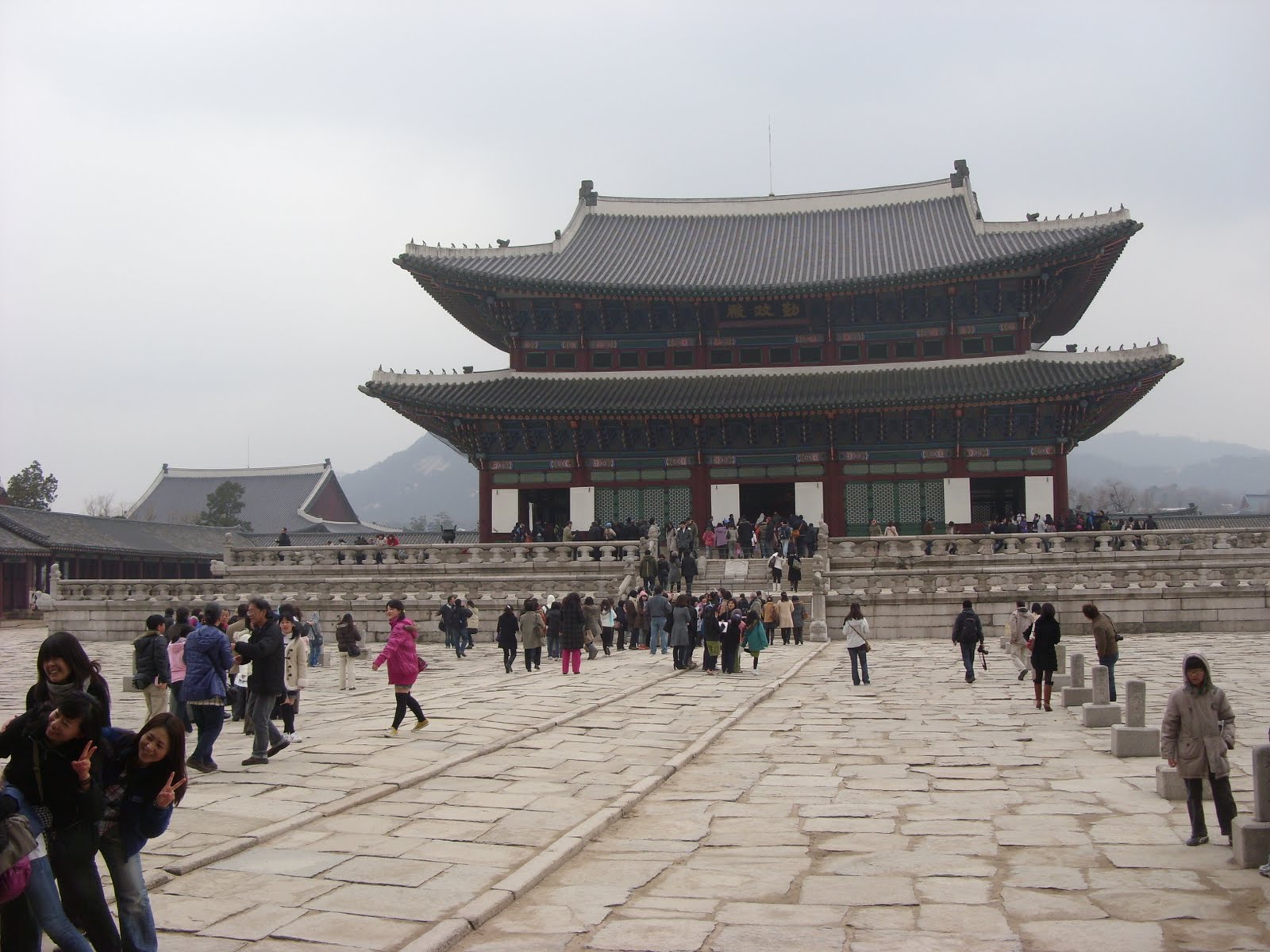
We just returned from the most delightful weekend trip visiting friends, Kurt and his wife J.Sun, in the soul (Yongsan) of Seoul. We made the trip on the KTX bullet train that speeds cross-country in less than two hours.  Here are a few photo's from our travels.
Geunjeongjeon at Gyeongbokgung Palace

A Gapsa Guard protecting the Palace Gate

The King's Throne in Geunjeongjeon

On the steps in front of Jibokjae (a reception hall for foreign envoys).

A study within Cheonchujeon next to Sajeongjeon -- "Hall where the king should thnk deeply before deciding what is right or wrong."
Mr. Park, a gentleman who volunteered to serve as our guide throughout the grounds of Gyeongbokgung.

Changing of the Gate Guard Ceremony

The viewof Seoul from Kurt & J.Sun's apartment on the 22nd floor of their building.

J.Sun, Sandy and Kurt in the gardens outside the Dragon Hill Lodge on Yongsan Base. Kurt is a Captain in the U.S. Army and the son of good friends from back in St. Louis.
Korean War Memorial Museum

Sunday afternoon shopping along the streets in the heart of Seoul.

23 March 2010

A Sunny Day at Sunrise Park

We hesitated to step out of our apartment Saturday morning.  It was too good to be true.  The morning skies looked sunny. The temperature might actually have risen. After just a bit of hesitation, we ventured out. Our weak faith in Pohang's March weather was strengthened!  Yes!  Yes!  It is truly warm. There's not a trace of clouds in the sky. Those are birds we hear singing out their calls.  That is a fragrance of cherry blossoms in the air!  Let's pack a picnic and head out to the bus stop.  We're on our way to the park!

For those of you who know St. Louis, you know that Forest Park is the crown jewel of the many public parks spread throughout both city and county.  For Pohang, Sunrise Park is their Forest Park. It is situated on the eastern side of the city along the natural bay that makes Pohang one of the principal port cities of Korea.  A short 15-minute bus ride from Handong's campus brings us to the southeastern entrance of Sunrise Park.
Across the street from the park rises a series of apartment towers forming one of the many typical housings complexes found throughout the city of Pohang. If you visit nearly any sizeable city in Korea, you will see similar apartment buildings. There are countless numbers of them.
Under a beautiful blue sky, we enjoyed a wonderful walk up the hillsides and through the park's gardens with their lovely arrangements of enormous granite rocks, both hardwood and fruit trees as well as shrubberies and flowers.  The trees are just starting to bud and the flowers are almost in bloom.  The warm sunshine and the calm sea breezes made for delightful temperatures through the morning and into the early afternoon.
Sandy and I enjoyed our picnic lunch on the steps of the amphitheater that overlooks the sea, and then, having been recharged, we ventured back along the trials up and over the hills toward the new museum of steelworks that will shortly be opening. (Did I mention in previous posts that Pohang is the steel capital of Korea?  Pohang is to Korea what Pittsburg is to the U.S. and what Sheffield and Birmingham are to England.)
After a quick bit of shopping at the local Lee Plus (like your neighborhood Walgreens without the pharmacy), we hopped on the next Handong bus back to campus and enjoyed a well-earned late afternoon nap.  Our delightful day at Sunrise Park convinced us that Pohang truly is a sunny place!