What can I say? I think Sandy put it best in her email to me, "Koreans really know how to celebrate!" And so began the celebrations this past week on Tuesday evening with a "Pre-Birthday Pizza Party" @ one of my students' favorite spots -- "Mr. Pizza" That's a Hawaiian Special with the candles atop it in front of me.
After enjoying our pizza and endless salad bar feast (the true attraction here -- all you can eat salads!!), we played a hilarious game of "Pictionary" using words and phrases from the case these Law & Advocacy students are preparing for Mock Trial in a couple of weeks. So, what picture would you draw if the phrase you were given was "in loco parentis" ?
But, the celebrations didn't end there, even though that would have been an amazingly fabulous time. No, from Mr. Pizza we all walked down the stroll through Yukkuri (the downtown shopping and entertainment district) to what you in the States would call a karaoke club, but what is here called a noraebang (singing room).
That's right, each group that comes in gets its own room equipped with an amazing karaoke machine housing literally tens of thousands of favorite songs from all generations and genres! I'm told this is the number one form of party entertainment in Korea. I was happy to join right in. It was my birthday, right?? Well, pre-birthday, at least!! Ms. YeEun Han, Mr. Vu and I crooned "My Heart Will Go On" together. What a blast!
The pre-birthday party was so overwhelming that I had to take a day of rest on Wednesday! Several students stopped by my office during the day, though, to drop off wonderful little gifts and cards. One, Ms. Ha, even presented me with some home-made rich dark chocolates!! Couldn't even eat half a bite without a glass of milk!! Amazing!
Another student, Ms. Grimi Kim, brought me two small cactus plants for my office. Each gift was accompanied with a beautiful card containing more than just the ordinary "Happy Birthday" wishes you find on American cards. Every card conveyed a hand-written expression of good wishes and prayers. Then, about 9:30 Wednesday evening I received a call from Ms. Shin, the president of our Law & Advocacy study group asking if she and another student might drop-off "something" at my apartment later on that evening.
"Later on" turned-out to be nearly 11:30pm and the two students turned into over a dozen carrying with them a cake, presents and a large decorated envelope full of birthday cards. They sang the "Happy Birthday" song twice as the midnight hour approached, and we all enjoyed pieces of the delicious cake. At the stroke of the new day, they all became the very first to wish me "Happy Birthday" on the Fifth of May! What amazing students I have!!
Their presents included a beautiful orchid plant for my office and a jar of hard candies that one very special and preceptive student had noticed I particularly enjoy. They do not miss a beat!! When I started to open their cards, though, everyone said that I should wait until after they left. I think they knew that when I read them I might very likely start crying. And, after they did all depart around 12:30, I read them all and I did.
So now, I have been given a "pre-birthday" party and a strike-of-midnight birthday party, but the celebrations are, in fact, still just beginning. On the morning of the fifth, I awoke to a beautiful day and took my regular break-of-dawn walkabout campus and was serenaded by some of the most unusual bird songs I have yet to hear here in Korea. Could it have been that my birthday made me a bit more attentive to their tunes??
By eight, I was seated on the sidelines of the soccer field with students and fellow colleagues to watch our Law Department men engage the Engineering Department on the pitch. Unfortunately, our men could not engineer a sufficient number of successful shots on goal, and this one went into the books with disappointment. It was, though, a hard fought match, and after all, that is what we are daily called to give!
At eleven, I joined with my dear friends from the Pohang International Community core group and we journeyed the short distance from campus to Chilpo Beach, and what a beach party it was!!
We cooked-out and enjoyed a great meal together with the sea breeze blowing in our hair and the sun
beaming down on us!
Pastor Richie's son, Joseph, presented me with one of my most precious birthday gifts -- an original picture drawn and colored by Joseph to remind me of our day at the sea. (It has now been posted to a prominent spot on my refrigerator).
I even tried to convince Richie that it was a great day to join me in taking a swim in the ocean, but my powers of persuasion were not (fortunately for him and me) sufficiently potent on this occasion.
But wait, . . . . it was my birthday!!! . . . . don't I get to do what I want to do on my birthday??? Rest easy Sandy! I didn't end up going swimming, but I did have a thoroughly good time with the best of friends on an amazingly beautiful day at the beach!! I even jumped for joy!! Thanks, Boyeon, for convincing I could!!
And, you might think the celebrations had reached their zenith, but you would be wrong!! We're not done yet!! After returning to campus, cleaning off and out the sand I brought back in my clothes and on my legs and feet, I enjoyed a nap. Well, it was my birthday, right! I had to rest because I was due to meet my TA, Ms. Juyoun Han, and three other students for a birthday dinner at Hyoam Restaurant -- the nicest restaurant on campus.
Showing posts with label Special Occasions. Show all posts
10 May 2011
02 April 2011
Playing the Fool . . . and Teaching, too
I'm always trying to engage my students through new approaches that I hope will prompt them to examine different perspectives on the persistent questions of life. So, this past Friday I thought I might take a slightly different approach to April Fool's Day. I came to class dressed in a brown Franciscan-like habit and without my glasses or shoes (and sockless, too!).
To say my students were taken aback would be putting it somewhat mildly. Now, you have to understand that in Asian culture in general (and Korean culture in particular), students are taught to accept what their teachers present to them. That being said, many were still trying hard to suppress their laughter. Has professor gone completely crazy? Has separation from his wife and family driven him mad? Does he really think that he has become a monk?
None of those questions were expressly stated, but you can be sure most of them were puzzling more than one student's mind. So what was the point of this first of April performance? I wanted to do for my new students at Handong what I had first done for students at Missouri Baptist University seven years ago on another April fool’s Day. In the attire of a follower of Francis of Assisi, I told them his story and how he came to be known as Francis the Fool.
I had been assigned the responsibility of giving the message for the student chapel service at MBU on the first of April. Earlier that year, I had read G.K. Chesterton's Life of St. Francis. Chesterton's portrayal of Francis challenged me to think more deeply about what it means to follow Jesus fully. Francis sought to live as Jesus lived and to love as Jesus loved. He reached out and touched the leper just as Christ had done. He left behind the wealth and security offered him by his family in order to find the fullness of life as he took seriously Christ's teaching to consider the birds of the air and the flowers of the field.
Having been so challenged by Francis' life, it was quite obvious to me that I was meant to tell his story in that chapel service on the first of April seven years ago. I thought it would make a more memorable impression if I told the story as Francis himself. So, now here at Handong, I wanted to continue the tradition and pass along the lessons from the life of the one who was called "Francis the Fool" -- a name that I'm sure he did not resent since he was seeking to follow the one who many had regarded as "God's own Fool."
Evidently that chapel message seven years ago was memorable. When one of my Handong student's posted the picture above to facebook during our Friday morning class, one of my former students from MBU, who was on-line at the time, commented within minutes: "I remember that robe!" I guess, playing the fool can sometimes be an effective means of teaching.
17 March 2011
The Breastplate of St. Patrick
I bind unto myself today
The strong Name of the Trinity,
By invocation of the same,
The Three in One and One in Three.
I bind this day to me for ever.
By power of faith, Christ's incarnation;
His baptism in the Jordan river;
His death on Cross for my salvation;
His bursting from the spicèd tomb;
His riding up the heavenly way;
His coming at the day of doom;*
I bind unto myself today.
I bind unto myself the power
Of the great love of the cherubim;
The sweet 'well done' in judgment hour,
The service of the seraphim,
Confessors' faith, Apostles' word,
The Patriarchs' prayers, the Prophets' scrolls,
All good deeds done unto the Lord,
And purity of virgin souls.
I bind unto myself today
The virtues of the starlit heaven,
The glorious sun's life-giving ray,
The whiteness of the moon at even,
The flashing of the lightning free,
The whirling wind's tempestuous shocks,
The stable earth, the deep salt sea,
Around the old eternal rocks.
I bind unto myself today
The power of God to hold and lead,
His eye to watch, His might to stay,
His ear to hearken to my need.
The wisdom of my God to teach,
His hand to guide, His shield to ward,
The word of God to give me speech,
His heavenly host to be my guard.
Against the demon snares of sin,
The vice that gives temptation force,
The natural lusts that war within,
The hostile men that mar my course;
Or few or many, far or nigh,
In every place and in all hours,
Against their fierce hostility,
I bind to me these holy powers.
Against all Satan's spells and wiles,
Against false words of heresy,
Against the knowledge that defiles,
Against the heart's idolatry,
Against the wizard's evil craft,
Against the death wound and the burning,
The choking wave and the poisoned shaft,
Protect me, Christ, till Thy returning.
Christ be with me, Christ within me,
Christ behind me, Christ before me,
Christ beside me, Christ to win me,
Christ to comfort and restore me.
Christ beneath me, Christ above me,
Christ in quiet, Christ in danger,
Christ in hearts of all that love me,
Christ in mouth of friend and stranger.
I bind unto myself the Name,
The strong Name of the Trinity;
By invocation of the same.
The Three in One, and One in Three,
Of Whom all nature hath creation,
Eternal Father, Spirit, Word:
Praise to the Lord of my salvation,
Salvation is of Christ the Lord.
By invocation of the same,
The Three in One and One in Three.
I bind this day to me for ever.
By power of faith, Christ's incarnation;
His baptism in the Jordan river;
His death on Cross for my salvation;
His bursting from the spicèd tomb;
His riding up the heavenly way;
His coming at the day of doom;*
I bind unto myself today.
I bind unto myself the power
Of the great love of the cherubim;
The sweet 'well done' in judgment hour,
The service of the seraphim,
Confessors' faith, Apostles' word,
The Patriarchs' prayers, the Prophets' scrolls,
All good deeds done unto the Lord,
And purity of virgin souls.
I bind unto myself today
The virtues of the starlit heaven,
The glorious sun's life-giving ray,
The whiteness of the moon at even,
The flashing of the lightning free,
The whirling wind's tempestuous shocks,
The stable earth, the deep salt sea,
Around the old eternal rocks.
I bind unto myself today
The power of God to hold and lead,
His eye to watch, His might to stay,
His ear to hearken to my need.
The wisdom of my God to teach,
His hand to guide, His shield to ward,
The word of God to give me speech,
His heavenly host to be my guard.
Against the demon snares of sin,
The vice that gives temptation force,
The natural lusts that war within,
The hostile men that mar my course;
Or few or many, far or nigh,
In every place and in all hours,
Against their fierce hostility,
I bind to me these holy powers.
Against all Satan's spells and wiles,
Against false words of heresy,
Against the knowledge that defiles,
Against the heart's idolatry,
Against the wizard's evil craft,
Against the death wound and the burning,
The choking wave and the poisoned shaft,
Protect me, Christ, till Thy returning.
Christ be with me, Christ within me,
Christ behind me, Christ before me,
Christ beside me, Christ to win me,
Christ to comfort and restore me.
Christ beneath me, Christ above me,
Christ in quiet, Christ in danger,
Christ in hearts of all that love me,
Christ in mouth of friend and stranger.
I bind unto myself the Name,
The strong Name of the Trinity;
By invocation of the same.
The Three in One, and One in Three,
Of Whom all nature hath creation,
Eternal Father, Spirit, Word:
Praise to the Lord of my salvation,
Salvation is of Christ the Lord.
07 June 2010
Happy Birthday, Thea!
Today is my older daughter Thea's birthday. (I'll let her tell you which one it is). She's the wife of Juan Luis, and mother of Taya Maria, Maya Theresa and Aydan Juan. She's a teacher at both Rockwood Summit High School and Missouri Baptist University. She's also an event coordinator for MBU's annual commencement exercises as well as weddings and other special events for many. Now, in addition to everything else, she's working on her second Master's degree -- this one at the University of Missouri - St.Louis in English. By God's good grace, she has accomplished much already in her life and will continue to have a positive impact upon the lives of her family, friends and her students.
I am very proud of you, Thea! Happy Birthday! Enjoy the special gift I sent along to you last week -- the safe return of your children's grand mother! (Save a piece of that birthday pie for me.)
06 June 2010
Hahoe Village -- The Williamsburg of Korea
One of our last opportunities to experience the wonder and beauty of Korean culture was provided to Sandy and me when my Teaching Assistant, Mr. Mok, and his girl friend Narang, treated us, a few weeks back, to a day of touring in Andong -- one of the most traditional cities in Korea. The high-light of the trip was the our visit to Hahoe Folk Village. Hahoe is one of the most well-preserved traditional villages in the entire country.
The decendants of one family -- the Ryu's -- have lived in this village for over 600 years. Although they have added some modern updates -- electicity and plumbing, as well as automobiles and tractors -- the homes and other structures within the village are authentic. As we walked toward the village on a path through the surrounding wooded hills, I realized that we were about to enter the "Colonial Williamsburg" of Korea.
Just inside the primary entrance to the village, we came upon this example of a traditional home. This is actually just the front gate entrance to the family's compound. It consists of retored and updated structures owned by the CEO of a large Korean corporation. Our guide told that the reconstruction costs were in excess of $5 million US.
Here's Sandy and our guide, Young Ju, walking down a typical street in Hahoe.
Each of the established (wealthy) family homes is actually a compound of several buildings enclosed by a stone wall. Within the walls there will be a main dwelling for the women of the family, another dwelling for the men, dwelling for the servants usually built onto the interior side of the surrounding wall. Most of the family compounds will also have a Guest House like the one pictured above.
Within the walls of the next family compound, this calligrapher had set up a tent and would gladly write a word of phase of your choosing. I asked him to write the name that my department chair, Profressor Chi, had given me: 高 德
Situated at the very center of Hahoe Village is this 600-year old zelkova tree which the villagers call "Samsindang". The name means "shrine for three gods." According to traditional animistic beliefs, the tree is worshipped as a spirit. On the 15th of every January (by the lunar calendar), the villagers perform a ritual at the tree to pray for the peace of the village.
When I was walking back along one of the paths, this little sparrow caught my attention. It reminded me that no matter where you go in the world, you always find sparrows. And when I remember what Jesus taught. Not one sparrow falls to ground without the Father's knowledge. And as God cares for the sparrows, you can be assured He cares for you. You are worth more than many sparrows.
Yangjindang, one of the oldest houses in Hahoe Village, belongs to the head of the Ryu clan in the P'ungsan area. It is one of the Korean national treasures. Ryu, Seong-ryong (1542-1607), a famous court minister who helped protect Korea from the Japanese invasion of 1592, lived here.This is a picture of the interior of the large meeting room within Yangjindang. I made the grevious mistake, though, of stepping-up on the wooden deck structure that surrounds the outside of the building. The sign warning against stepping-up was written in Korean only. I should, however, have asked our guide before stepping-up and taking these pictures. My offense resulted in one of the other Korean visitors (who had observed my disrespectful conduct) giving me a sound chewing-out as I was later told by our guide.
Just a few kilometers down the Nakdong River is located Dosan Confucian Academy, one of the oldest in Korea. At the top of these stairs is the entry gate to the shrine within the academy's grounds that was built to house the memorial tablet of Yi Hwang (이황). Yi is one of Korea’s most celebrated philosophers.
At the end of this very full and inspiring day, our guide, Young Ju Choi, asked another visitor to snap this photo. We thoroughly enjoyed our visit to the "Williamsburg" of Korea.
29 May 2010
Two Weddings and a Talent Show
Earlier this month, Sandy and I were invited to attend the weddings of two teachers from the KEBS Sunday School class that we help to teach at The Joyful Church in Pohang. Pictured above is our friend Samuel and his new bride. Their parents stand together on each side of them as they are presented to their 500+ guests as husband and wife for the first time. Korean weddings are very elaborate affairs. Both of the weddings we attended (one on Saturday and the other on Sunday afternoon) were held in the Grand Ballroom of the Philos Hotel -- the biggest hotel in Pohang.
In between these two formal events, we were invited to serve as judges that Saturday night for the University's International Student Union "Open-Mic" talent show. Our trainer, Aleksey, was among the many contestants. As a graduating senior this semester, he sang a parting song that brought tears to many of the young ladies' eyes. I was happy when the other five judges agreed with me that Aleksey was clearly one of the top performers of the night. He won second place! I was called upon to announce the winners and hand-out their prizes.
We enjoyed a full weekend of celebration and quite a bit of fun! There was a striking similarity, though, between the weddings and the talent show. All three were very much staged "productions." At both weddings, special songs were sung by friends of the bride and groom. The second wedding even featured a singer who is well-known in Korean popular culture. The weddings themselves were performed in the midst of banquet tables at which many of the guests had already begun to eat and drink even as the ceremony was occurring.
The weddings were, however, distinctly marked by the honor given to the parents of the bride and groom in Korean culture. At the point in the wedding ceremony when American bride's and groom's would give roses to their mothers, the newly wed Korean couple is instructed by the presiding minister to turn first to the parents of the groom and bow. The bride bows from the waist so that her upper body is at nearly a 90 degree angle to her lower body. The groom, however, goes down on his knees and then bows with his arms extended out in front of him along the floor and with his face all the way down to the ground.
After bowing to the parents of the groom, the couple comes across to the parents of the bride and the same bowing ritual is performed in their honor. The value and respect such actions showed to the parents of the married couple was definitely the hallmark of the ceremonies and what -- in the midst of a fun and entertaining weekend -- we will remember most from these two weddings and a talent show.
22 May 2010
How Do You Celebrate Buddha's Birthday?
The 21st of May is a national holiday in Korea.
It is the Buddha's birthday.
So, how do you celebrate?
The answer I suggested to my students was this:
"Be Awake!"
“Awake, O sleeper, and arise from the dead, and Christ will shine on you.”
Ephesians 5:14
(The pensive Buddha, pictured at right, is a Korean national treasure.)
It is the Buddha's birthday.
So, how do you celebrate?
The answer I suggested to my students was this:
"Be Awake!"
“Awake, O sleeper, and arise from the dead, and Christ will shine on you.”
Ephesians 5:14
(The pensive Buddha, pictured at right, is a Korean national treasure.)
14 May 2010
Happy Birthday, Hannah!
Our daughter Hannah is celebrating her 27th birthday this week. Her day is May 13, but in our family, we do our best to stretch out our birthday celebrations for at least a week. In order to make sure that my gift would arrived by or before the 13th, I put it in the mail here in Korea 10 days ago. Sandy put a card in the mail to Hannah the following day. Yesterday, when checking her email, Sandy noticed that Hannah was on-line and connected with her via Skype for a video call to wish her a happy birthday and catch-up on all her news from the home front.
So, here's another of our on-going birthday good wishes to keep the celebration progressing! Congratulations, Hannah, on your new position as the Sous Chef at Molly's in Soulard! With your 11 years of experience in fine-dining, you have well-earned this recognition. (By the way, I strongly encourage all our friends in the St. Louis to make the trip down to Molly's for lunch. You will have a thoroughly enjoyable time!) Its one of the first places I plan to take Sandy as we re-accustom ourselves to American cuisine once again.
Continue enjoying the celebration of your birthday, Hannah!
Don't spend all that 27,000 Korean Won I sent you in one place!
So, here's another of our on-going birthday good wishes to keep the celebration progressing! Congratulations, Hannah, on your new position as the Sous Chef at Molly's in Soulard! With your 11 years of experience in fine-dining, you have well-earned this recognition. (By the way, I strongly encourage all our friends in the St. Louis to make the trip down to Molly's for lunch. You will have a thoroughly enjoyable time!) Its one of the first places I plan to take Sandy as we re-accustom ourselves to American cuisine once again.
Continue enjoying the celebration of your birthday, Hannah!
Don't spend all that 27,000 Korean Won I sent you in one place!
09 May 2010
A Red-Letter Day
The 5th of May is a national holiday in Korea. On every Korean calendar the date is highlighted in red. Its Children's Day. Everyone gets the day off from work to spend the entire day with their children. Here on campus all classes were cancelled, and even the weekly faculty meetings that are ordinarily held every Wednesday were post-poned until next week. Most of the faculty members plan outings with their families at the local park or hikes into the foothills of the surrounding mountains.
A few of my Law & Advocacy Study Group students had learned that May 5 was also my birthday, so they invited Sandy and me to a brunch at Hyoam Restaurant. I wasn't exactly sure what would be on the bunch menu, but I was looking forward to an enjoyable, leisurely morning with some of my brightest students. When we arrived at the Restaurant, though, I was a bit confused to find that none of my students had shown-up. Koreans generally tend to be somewhat late to events, but when students plan a meal for their professor they usually arrive well in advance to make preparations.
The owner of the restaurant must have noticed that I was puzzled, so he suggested that Sandy and I should wait in the special dining room and assured me that my students were "on their way." About ten minutes later -- as we were considering putting out a call to the study group leader -- the doors on both ends of the dining room opened, and my students processed in singing the traditional Korean birthday song to a guitar accompaniment. The song was followed by the presentation of a beautifully decorated cake sporting one, tall and thin, lit candle. As I accepted the cake, the whole group together sang "Happy Birthday to You" in English.
At the end of the song, they all encouraged me to blow-out the single candle. They explained that, while they knew this was not my first birthday (by a long shot, a 50-year long shot), it was the first of my birthday's to be celebrated in Korea. They wished for me to celebrate many more birthdays here at Handong in the future. Some already knew of our decision to return to the States this summer, but they were still attempting to use their influence to persuade me to stay longer.
Next, I was presented with a rice paper scroll from Prof. Chi, the chairman of the School of Law, on which he had hand-painted in Chinese calligraphy the characters Ko Deok (shown below) which one student translated for me as "high character" or "practicing the highest good". It is the name that Prof. Chi has given to me.
Another of my students then presented me with a gift box (about 8 inches x 8 inches x 5 inches in size) in which I found some 50 small pieces of orange paper all rolled-up in scrolls. I later unrolled each of the orange scrolls to find a special individual birthday wish written by my students. Some expressed their wishes in their language and provided me with a translation, others even drew pictures.
The final gift was presented when we all took our seats around the tables. I had cut the cake for everyone to enjoy, but just before I could take a bite, Ms. Han -- the leader of my student study group -- placed in front of me a bowl of traditional Korean birthday soup that she had prepared herself. It consists of a broth with a healthy amount of seaweed, an excellent source of nutrients, topped with a small portion of beef. Along with the soup, a bowl of rice is also served. The soup is an expression of everyone's wish that the one celebrating his birthday experience a long and healthy life. I ate nearly all of it before moving on to the less-than-health-enhancing (but delicious) cake.
Needless to say, I was quite overwhelmed by the thoughtfulness and kindness of my students and fellow colleagues. It will be a birthday celebration that I will long remember -- a true red-letter day!
A few of my Law & Advocacy Study Group students had learned that May 5 was also my birthday, so they invited Sandy and me to a brunch at Hyoam Restaurant. I wasn't exactly sure what would be on the bunch menu, but I was looking forward to an enjoyable, leisurely morning with some of my brightest students. When we arrived at the Restaurant, though, I was a bit confused to find that none of my students had shown-up. Koreans generally tend to be somewhat late to events, but when students plan a meal for their professor they usually arrive well in advance to make preparations.
The owner of the restaurant must have noticed that I was puzzled, so he suggested that Sandy and I should wait in the special dining room and assured me that my students were "on their way." About ten minutes later -- as we were considering putting out a call to the study group leader -- the doors on both ends of the dining room opened, and my students processed in singing the traditional Korean birthday song to a guitar accompaniment. The song was followed by the presentation of a beautifully decorated cake sporting one, tall and thin, lit candle. As I accepted the cake, the whole group together sang "Happy Birthday to You" in English.
At the end of the song, they all encouraged me to blow-out the single candle. They explained that, while they knew this was not my first birthday (by a long shot, a 50-year long shot), it was the first of my birthday's to be celebrated in Korea. They wished for me to celebrate many more birthdays here at Handong in the future. Some already knew of our decision to return to the States this summer, but they were still attempting to use their influence to persuade me to stay longer.
Next, I was presented with a rice paper scroll from Prof. Chi, the chairman of the School of Law, on which he had hand-painted in Chinese calligraphy the characters Ko Deok (shown below) which one student translated for me as "high character" or "practicing the highest good". It is the name that Prof. Chi has given to me.
Another of my students then presented me with a gift box (about 8 inches x 8 inches x 5 inches in size) in which I found some 50 small pieces of orange paper all rolled-up in scrolls. I later unrolled each of the orange scrolls to find a special individual birthday wish written by my students. Some expressed their wishes in their language and provided me with a translation, others even drew pictures.
The final gift was presented when we all took our seats around the tables. I had cut the cake for everyone to enjoy, but just before I could take a bite, Ms. Han -- the leader of my student study group -- placed in front of me a bowl of traditional Korean birthday soup that she had prepared herself. It consists of a broth with a healthy amount of seaweed, an excellent source of nutrients, topped with a small portion of beef. Along with the soup, a bowl of rice is also served. The soup is an expression of everyone's wish that the one celebrating his birthday experience a long and healthy life. I ate nearly all of it before moving on to the less-than-health-enhancing (but delicious) cake.
Needless to say, I was quite overwhelmed by the thoughtfulness and kindness of my students and fellow colleagues. It will be a birthday celebration that I will long remember -- a true red-letter day!
16 April 2010
So . . . What's It Take to Find a Good Chinese Restaurant around Pohang, Korea?
This past weekend, my wife and I had the pleasure of returning the favor of hospitality to our new friends from Seoul, Kurt and J.Sun. They had traveled Friday along with their friends, Sam and Suzanne, over to the southeast coast to tour in the beautiful island of Tongyeong. Then, Saturday afternoon, they gave us a call to let us know that they were on their way driving north and anticipated arriving at Handong in a few hours. We had made reservations for them at the Pine Beach Hotel on Chilpo Beach. (This particular hotel gives all guests from Handong a 30% discount, so we thought that this would be an ideal place for them to stay). Chilpo is one of several less crowed areas (at least at this time of the year) to the north of downtown Pohang. The hotel itself sits back from the sandy beach with a beautiful, unobstructed view of the sea to the east.
As the time for their arrival drew near, we walked across campus to greet our visitors in front of the University's chapel -- the prominent landmark that greets everyone at the top of the entrance drive leading up the hillside from the new highway that now runs through the valley below our campus. I had suggested to Kurt that he might want to by-pass Pohang as they drove up from the south around the city on the new highway and come in from the west. What I did not realize, though, was that the highway is so new that all the its interchanges have not been completely constructed, and when our friends tried to enter on to the new Interstate (since there are no "states" in Korea, I guess I should call it the "Interprovincial" highway), they could only travel east back toward Daegu, and not west toward our campus.
This unfortunate bit of misdirection resulted in their arrival being delayed until a little after 6pm. Once they did arrive, though, we were able to take a nice strolling tour around the campus with notable stops at All Nations Hall to see both Sandy's and my offices. Then, we continued our walk along the south campus drive and reached our apartment for a short time of light refreshment and conversation, and yes, all six of us were able to squeeze into our studio, though some of us had to stand. (By this point in the story, you might be asking yourself what all this has to do with finding a Chinese restaurant, so here is where the plot thickens).
Our friends had been traveling quite comfortably over the past two days in their Honda Accord – adequate room for four, but six would be a bit tight. So, I called my trusty TA, Mr. Mok, who in turn, summoned a taxi in which Sandy and I would ride through the countryside to Chilpo Beach – the taxi being the guide for our friends to follow in their Honda. (Have I mentioned the tendency of Korean cabdrivers to drive as excessive rates of speed along even the narrowest of roadways?) Picture this – the time is about 7:30 in the evening. The sun has set and darkness is now covering the countryside. One lone taxi speeds along a narrow road followed at varying lengths by a Honda Accord that is clearly doing its best to keep up with each twist and turn along the way. Finally, we drive into the parking lot of the Pine Beach Hotel as the beach is shadowed in the dark of night.
In the distance, the flickering neon sign in the window of the hotel’s famed Chinese restaurant glimmered, and just as we step out of the cars, that sign’s light was extinguished. I suggested that it might be a good idea for our friends to go ahead and check-in so that we could confirm that the room reservations my TA had made were in fact being “held” (those of you familiar with the Jerry Seinfeld Show will recall that what is important is not just the “making” of the reservation, but the “holding” of it) through the evening. Thankfully, the rooms were still available – although one had only twin beds and not a single full-sized bed. Having secured the rooms for our guests, we now set upon to find a Chinese restaurant since the one that we had promised to them in the lobby of the hotel had indeed closed its kitchen just moments before our arrival.
My first thought was to call Mr. Mok and have him order from another nearby Chinese restaurant that I knew delivered to Handong; so I hoped it might also deliver to the hotel where we were on Chilpo Beach. When the innkeeper learned of my plan, though, she recommended that we drive a short 5 minutes north into the next village where she assured us we would find a delightful Chinese restaurant that would be quite suitable for our needs. What I only just then learned, however, was that our friends had not stopped to eat a regular meal all day. They were – and I think this is the first time in this blog that I can actually use this word in all its fullness – famished!
So, rather than waiting for a delivery from a restaurant that I knew, we – all six of us – piled into the Accord – the taxi was long gone by now – and set out to find that Chinese restaurant in the next seaside village up the coastal roadway. True to the innkeeper’s estimation, J. Sun spotted the sign for the restaurant within a short 5-minute drive. But as we turned into the yard in front of the building, we noticed a lady coming out the front door onto the porch. It looked as if she was just about to close and lock the door and turn-off the light.
In a flash, J. Sun pealed herself out of the front passenger seat she had been occupying with Suzanne and ran over to the restaurant owner with what must have been perceived by this dear little lady as a dire request for dinner. I didn’t overhear the exchange, but within mere moments, we were all warmly welcomed into the restaurant as the lady and her husband turned the lights back on and began to fire-up the stove in the kitchen.
What a relief! For the next hour or so, we all sat cross-legged with chopsticks in hand around the center table in the restaurant’s single dining room and enjoyed a wonderful feast of several entrées, including but not limited to, sweet and sour pork along with hand-made noodles and black beans – the local substitute for fried rice in these parts. At the end of this very long day for our new friends, we were able to share a delightful meal together with fervent fellowship around the table of a well-found Chinese Restaurant on the eastern seacoast of beautiful Korea just a tad north of Chilpo Beach.
That’s what it takes.
As the time for their arrival drew near, we walked across campus to greet our visitors in front of the University's chapel -- the prominent landmark that greets everyone at the top of the entrance drive leading up the hillside from the new highway that now runs through the valley below our campus. I had suggested to Kurt that he might want to by-pass Pohang as they drove up from the south around the city on the new highway and come in from the west. What I did not realize, though, was that the highway is so new that all the its interchanges have not been completely constructed, and when our friends tried to enter on to the new Interstate (since there are no "states" in Korea, I guess I should call it the "Interprovincial" highway), they could only travel east back toward Daegu, and not west toward our campus.
This unfortunate bit of misdirection resulted in their arrival being delayed until a little after 6pm. Once they did arrive, though, we were able to take a nice strolling tour around the campus with notable stops at All Nations Hall to see both Sandy's and my offices. Then, we continued our walk along the south campus drive and reached our apartment for a short time of light refreshment and conversation, and yes, all six of us were able to squeeze into our studio, though some of us had to stand. (By this point in the story, you might be asking yourself what all this has to do with finding a Chinese restaurant, so here is where the plot thickens).
Our friends had been traveling quite comfortably over the past two days in their Honda Accord – adequate room for four, but six would be a bit tight. So, I called my trusty TA, Mr. Mok, who in turn, summoned a taxi in which Sandy and I would ride through the countryside to Chilpo Beach – the taxi being the guide for our friends to follow in their Honda. (Have I mentioned the tendency of Korean cabdrivers to drive as excessive rates of speed along even the narrowest of roadways?) Picture this – the time is about 7:30 in the evening. The sun has set and darkness is now covering the countryside. One lone taxi speeds along a narrow road followed at varying lengths by a Honda Accord that is clearly doing its best to keep up with each twist and turn along the way. Finally, we drive into the parking lot of the Pine Beach Hotel as the beach is shadowed in the dark of night.
In the distance, the flickering neon sign in the window of the hotel’s famed Chinese restaurant glimmered, and just as we step out of the cars, that sign’s light was extinguished. I suggested that it might be a good idea for our friends to go ahead and check-in so that we could confirm that the room reservations my TA had made were in fact being “held” (those of you familiar with the Jerry Seinfeld Show will recall that what is important is not just the “making” of the reservation, but the “holding” of it) through the evening. Thankfully, the rooms were still available – although one had only twin beds and not a single full-sized bed. Having secured the rooms for our guests, we now set upon to find a Chinese restaurant since the one that we had promised to them in the lobby of the hotel had indeed closed its kitchen just moments before our arrival.
My first thought was to call Mr. Mok and have him order from another nearby Chinese restaurant that I knew delivered to Handong; so I hoped it might also deliver to the hotel where we were on Chilpo Beach. When the innkeeper learned of my plan, though, she recommended that we drive a short 5 minutes north into the next village where she assured us we would find a delightful Chinese restaurant that would be quite suitable for our needs. What I only just then learned, however, was that our friends had not stopped to eat a regular meal all day. They were – and I think this is the first time in this blog that I can actually use this word in all its fullness – famished!
So, rather than waiting for a delivery from a restaurant that I knew, we – all six of us – piled into the Accord – the taxi was long gone by now – and set out to find that Chinese restaurant in the next seaside village up the coastal roadway. True to the innkeeper’s estimation, J. Sun spotted the sign for the restaurant within a short 5-minute drive. But as we turned into the yard in front of the building, we noticed a lady coming out the front door onto the porch. It looked as if she was just about to close and lock the door and turn-off the light.
In a flash, J. Sun pealed herself out of the front passenger seat she had been occupying with Suzanne and ran over to the restaurant owner with what must have been perceived by this dear little lady as a dire request for dinner. I didn’t overhear the exchange, but within mere moments, we were all warmly welcomed into the restaurant as the lady and her husband turned the lights back on and began to fire-up the stove in the kitchen.
What a relief! For the next hour or so, we all sat cross-legged with chopsticks in hand around the center table in the restaurant’s single dining room and enjoyed a wonderful feast of several entrées, including but not limited to, sweet and sour pork along with hand-made noodles and black beans – the local substitute for fried rice in these parts. At the end of this very long day for our new friends, we were able to share a delightful meal together with fervent fellowship around the table of a well-found Chinese Restaurant on the eastern seacoast of beautiful Korea just a tad north of Chilpo Beach.
That’s what it takes.
28 March 2010
Souls Refreshed in Seoul
We just returned from the most delightful weekend trip visiting friends, Kurt and his wife J.Sun, in the soul (Yongsan) of Seoul. We made the trip on the KTX bullet train that speeds cross-country in less than two hours. Here are a few photo's from our travels.
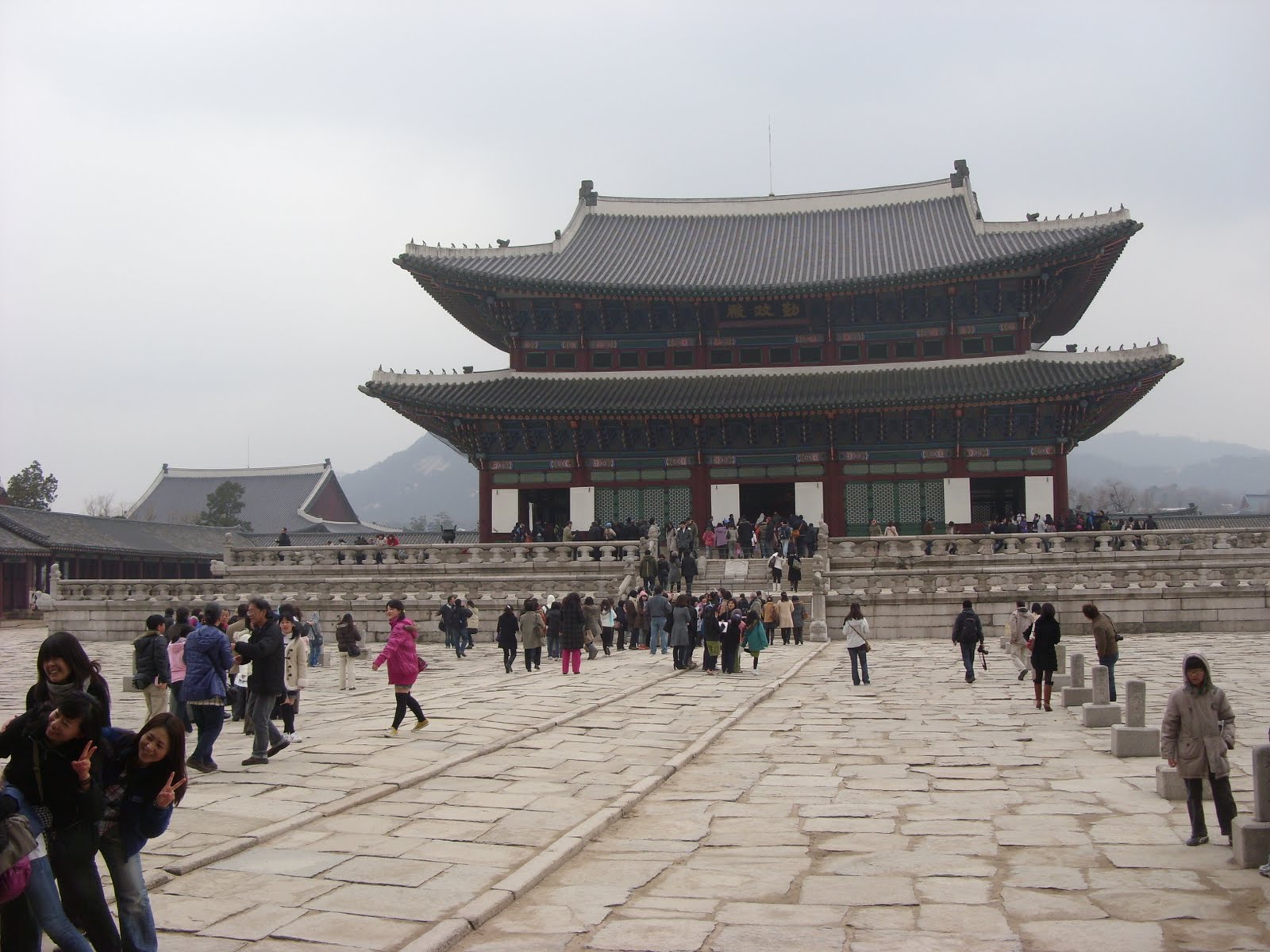
Geunjeongjeon at Gyeongbokgung Palace
A Gapsa Guard protecting the Palace Gate
The King's Throne in Geunjeongjeon
On the steps in front of Jibokjae (a reception hall for foreign envoys).
A study within Cheonchujeon next to Sajeongjeon -- "Hall where the king should thnk deeply before deciding what is right or wrong."
Mr. Park, a gentleman who volunteered to serve as our guide throughout the grounds of Gyeongbokgung.
Changing of the Gate Guard Ceremony
The viewof Seoul from Kurt & J.Sun's apartment on the 22nd floor of their building.
J.Sun, Sandy and Kurt in the gardens outside the Dragon Hill Lodge on Yongsan Base. Kurt is a Captain in the U.S. Army and the son of good friends from back in St. Louis.

Korean War Memorial Museum
Sunday afternoon shopping along the streets in the heart of Seoul.
26 February 2010
Happy 5th Birthday, Maya!
Our granddaughter Maya Theresa just turned 5 years old! Happy Birthday, Maya! One of the most difficult challenges for Grandma and Grandpa here in Korea comes from our being half-way around the world on these special days when we would love to be together with our little ones. I don't think we could survive such a separation if we did not have the wonders of the internet and especially the opportunity to enjoy video calls through Skype.
Sandy was delighted by a long talk with our daughter and the grand kids this morning. (It was early Thursday evening there in St. Louis). Maya was able to show and tell her grandma about the birthday bear she was built at the "Build-A-Bear" workshop. So, even though we can't be there in person, face-to-face, we can at least be present with one another face-to-face and voice-to-voice through the blessings of internet technology.
We wish and pray for you, our little princess Maya, all the happiness and blessings of God on this your fifth birthday!
Sandy was delighted by a long talk with our daughter and the grand kids this morning. (It was early Thursday evening there in St. Louis). Maya was able to show and tell her grandma about the birthday bear she was built at the "Build-A-Bear" workshop. So, even though we can't be there in person, face-to-face, we can at least be present with one another face-to-face and voice-to-voice through the blessings of internet technology.
We wish and pray for you, our little princess Maya, all the happiness and blessings of God on this your fifth birthday!
23 February 2010
Commencement @ the Commencement of the New Year
This past Saturday, Handong Global University convened its 12th Commencement Exercises. Throughout my teaching experience in the States, university commencement ceremonies were traditionally held at the end of the academic year. You would often hear speakers making the comment that though the ceremony occurred at the end of the academic year, it is called "Commencement" because it marks the beginning of a new stage in the life of each graduate.
The Asian tradition, however, places the graduation ceremony at the beginning of the academic year, and I think they get it right. Not only does Commencement mark a new start for the many students who are graduating, it also signals a new beginning for the entire university community. It was a joy to see several of my students, who I had had the privilege of teaching in the past fall term, step up to the platform as their names were announced.
Another excellent tradition is practiced by the faculty at Commencement here at Handong. The graduates are called up to the dais according to their schools. For example, all of the graduates from the School of Management and Economics are called forward and their names are read. Next, all the graduates from the School of Life Sciences are called forward. Later, the graduates from the School of Law, where I teach, are also called forward.
As each school's graduates are announced, the faculty from that school lines up across the platform. Groups of graduates step up in a line stretching across the dais with a student standing in front of each faculty member. The student bows to the professor and the professor then takes the tassel that hangs from the student's mortar board and moves it from the right side to the left side thus marking, by this symbolic gesture, the student's passing to the graduated status. The professor then congratulates the graduate with a hardy hand-shake and often, in this culture, a hug.
As the New Year here in Asia has recently been celebrated, it was a genuine pleasure to participate in Handong's 12th Commencement Ceremony at this the commencement of the new academic term!
The Asian tradition, however, places the graduation ceremony at the beginning of the academic year, and I think they get it right. Not only does Commencement mark a new start for the many students who are graduating, it also signals a new beginning for the entire university community. It was a joy to see several of my students, who I had had the privilege of teaching in the past fall term, step up to the platform as their names were announced.
Another excellent tradition is practiced by the faculty at Commencement here at Handong. The graduates are called up to the dais according to their schools. For example, all of the graduates from the School of Management and Economics are called forward and their names are read. Next, all the graduates from the School of Life Sciences are called forward. Later, the graduates from the School of Law, where I teach, are also called forward.
As each school's graduates are announced, the faculty from that school lines up across the platform. Groups of graduates step up in a line stretching across the dais with a student standing in front of each faculty member. The student bows to the professor and the professor then takes the tassel that hangs from the student's mortar board and moves it from the right side to the left side thus marking, by this symbolic gesture, the student's passing to the graduated status. The professor then congratulates the graduate with a hardy hand-shake and often, in this culture, a hug.
As the New Year here in Asia has recently been celebrated, it was a genuine pleasure to participate in Handong's 12th Commencement Ceremony at this the commencement of the new academic term!
15 February 2010
Happy Lunar New Year!
Our first full day here at Handong is actually the first day of the New Year on the Chinese calendar. February 15 marks the beginning of The Year of the Tiger. It seems appropriate that this day mark a new beginning for us. As I look back now, I'm realizing that my first semester was a time of preparation. This semester will be a time of challenge, no doubt, but I trust that it will also be a time of formation and growth both for Sandy and me personally and for us together in our relationship now in our 31st year of marriage.
We'll need to take each day step-by-step -- at a walking pace. Today we walked over to view the new apartment that had been assigned to us only to find that it had several issues that will prevent us moving in. We're making the most of my old studio apartment here in the Mission House where I lived last term. It actually is quite adequate for us.
Sandy even referred to the old apartment as my "tent" since it is just a bit bigger in space than a large family tent we borrowed and used many years ago on one of our family vacations with the kids in Colorado. Sandy has made the most of the limited cooking facilities and has already prepared a wonderful spaghetti dinner and an evening meal of pork mandoo and vegetables. I definitely won't go hungry this semester and it’s very likely that I won't be losing any weight even though I could stand to.
Tomorrow, Sandy will be treated to her first Korean shopping experience by one of the seasoned American faculty member's spouse, Danika. Her husband Eric and their four children have been here for six years. Eric (for my regular readers, you may recall how this faithful brother came to my aid by taking me to the emergency room last August when I cut my finger) has been teaching law at Handong International Law School (the graduate law school here). They're great friends who have shown us warm hospitality.
All in all, it looks like this New Year has begun well. We'll be trusting the Lord for grace each day as it progresses in these coming months.
We'll need to take each day step-by-step -- at a walking pace. Today we walked over to view the new apartment that had been assigned to us only to find that it had several issues that will prevent us moving in. We're making the most of my old studio apartment here in the Mission House where I lived last term. It actually is quite adequate for us.
Sandy even referred to the old apartment as my "tent" since it is just a bit bigger in space than a large family tent we borrowed and used many years ago on one of our family vacations with the kids in Colorado. Sandy has made the most of the limited cooking facilities and has already prepared a wonderful spaghetti dinner and an evening meal of pork mandoo and vegetables. I definitely won't go hungry this semester and it’s very likely that I won't be losing any weight even though I could stand to.
Tomorrow, Sandy will be treated to her first Korean shopping experience by one of the seasoned American faculty member's spouse, Danika. Her husband Eric and their four children have been here for six years. Eric (for my regular readers, you may recall how this faithful brother came to my aid by taking me to the emergency room last August when I cut my finger) has been teaching law at Handong International Law School (the graduate law school here). They're great friends who have shown us warm hospitality.
All in all, it looks like this New Year has begun well. We'll be trusting the Lord for grace each day as it progresses in these coming months.
14 December 2009
Unto Us a Son is Given
Just a few hours ago, I was enjoying a wonderful conversation with Sandy via Skype when our son Caleb called her from Portland to announce the glad tidings -- Micaela gave birth at 1:59pm (Pacific Time) Sunday (13 December 2009) to their first born son, Atreya Lynx Schulten.
He weighed in at 8 pounds (3.62 kilos for my friends here in Asia). He has light brown hair and a strong pair of lungs according to his papa! He is also a hungry little fellow as he took to nursing within minutes of his birth! Both mom and child are doing very well.
Atreya is the name of the 8th century BC physician and sage from India who is considered one of the founders of Indian medicine. Lynx is a Native American name and also the name of one of Caleb's good friends within the primitive living community. We are all rejoicing for his healthy and safe birth!
He weighed in at 8 pounds (3.62 kilos for my friends here in Asia). He has light brown hair and a strong pair of lungs according to his papa! He is also a hungry little fellow as he took to nursing within minutes of his birth! Both mom and child are doing very well.
Atreya is the name of the 8th century BC physician and sage from India who is considered one of the founders of Indian medicine. Lynx is a Native American name and also the name of one of Caleb's good friends within the primitive living community. We are all rejoicing for his healthy and safe birth!
09 December 2009
Sitting Down to Dine
This past Friday evening I had the privilege of being invited to the "End of Semester Party" put on by our International Student Union here at Handong. This is the same group that hosted the "open mic" night a few weeks back where I was asked to serve as one of the competition's judges. The invitation came by text message to my mobile. I was further advised that a car would come by to pick me up and transport me to the party venue. In many respects, I felt as if I were being given the VIP treatment.
The evening's festivities did not disappoint in any regard. If fact, the whole experience reflected all of the many and varied dimensions of the cross-cultural engagements I have been provided during my first four months of teaching here. The banquet afforded both traditional Korean dishes as well as a wide selection of entrées from throughout Asia and even a few Western-styled items. Needless to say, we were more than abundantly provided for.
But what was an even a greater blessing, though, was the delight and true joy I experienced from the fellowship of sitting around a table with students from eleven different countries, including Haiti, Congo, Cameroon, Tanzania, Ethiopia, Afghanistan, Tajikistan, Russia, Mongolia, China, and India. In addition, there were also students from Kenya, Thailand, Philippines and Korea. Nearly all the students joined in both singing and dancing to traditional songs from their home countries. It was one of those evenings that you wish would continue on for hours more.
As I read the Scriptures these days, the phrase “all nations” has begun to stand out in new ways. I sense that I am being given a small preview of the glorious gathering that awaits us when people from every tribe, language, and nation will join together in unity around the throne of God.
The evening's festivities did not disappoint in any regard. If fact, the whole experience reflected all of the many and varied dimensions of the cross-cultural engagements I have been provided during my first four months of teaching here. The banquet afforded both traditional Korean dishes as well as a wide selection of entrées from throughout Asia and even a few Western-styled items. Needless to say, we were more than abundantly provided for.
But what was an even a greater blessing, though, was the delight and true joy I experienced from the fellowship of sitting around a table with students from eleven different countries, including Haiti, Congo, Cameroon, Tanzania, Ethiopia, Afghanistan, Tajikistan, Russia, Mongolia, China, and India. In addition, there were also students from Kenya, Thailand, Philippines and Korea. Nearly all the students joined in both singing and dancing to traditional songs from their home countries. It was one of those evenings that you wish would continue on for hours more.
As I read the Scriptures these days, the phrase “all nations” has begun to stand out in new ways. I sense that I am being given a small preview of the glorious gathering that awaits us when people from every tribe, language, and nation will join together in unity around the throne of God.
06 December 2009
Thirty Years Ago
Thirty years ago, I was teaching sixth, seventh and eighth graders language arts and social studies in St. Louis, Missouri. Thirty years ago, my wife and I were awaiting the birth of our first child. And it was, thirty years ago today that Caleb Andrew was born.
Today, I'm teaching university students from over twenty-five different countries American law in Korea. Today, I'm celebrating the birthday of my son, though I'm nearly half-way around the world from him and his beautiful wife, Micaela. [That's them in a photo I took at their wedding out at Cuiver River State Park in August 2008 - thirty years after Sandy and my wedding in August 1978].
Today, Caleb and Micaela are now expecting the birth of their first child. So many wonderful events have occured over the past thirty years, and yet in some even more wonderful ways, the cycle of life is being renewed again by God's gracious goodness and mercy -- His faithfulness that is new to us each morning.
May you and Micaela continue to know God's good and gracious hand upon your lives, my Son! You are an amazing young man, and I am very proud of the man, the husband and soon to be father, that you have become!
Today, I'm teaching university students from over twenty-five different countries American law in Korea. Today, I'm celebrating the birthday of my son, though I'm nearly half-way around the world from him and his beautiful wife, Micaela. [That's them in a photo I took at their wedding out at Cuiver River State Park in August 2008 - thirty years after Sandy and my wedding in August 1978].
Today, Caleb and Micaela are now expecting the birth of their first child. So many wonderful events have occured over the past thirty years, and yet in some even more wonderful ways, the cycle of life is being renewed again by God's gracious goodness and mercy -- His faithfulness that is new to us each morning.
May you and Micaela continue to know God's good and gracious hand upon your lives, my Son! You are an amazing young man, and I am very proud of the man, the husband and soon to be father, that you have become!
30 November 2009
Birthday of a Great Author
The following is from Garrison Keillor's The Writer's Almanac.
It's the birthday of a writer who described life in the Mississippi River valley, whose most famous fiction and nonfiction is set along the river, and who got his pen name from being a riverboat captain, even though he spent most of his adult life traveling or living on the East Coast. That's Samuel Clemens, better known as Mark Twain, born on this day in Florida, Missouri (1835).
The town of Florida was about 30 miles inland from the Mississippi River, and Samuel's father, trained as a lawyer, was finding it impossible to support himself in Florida as a lawyer, or a politician or storekeeper, for that matter. So when Sam was four, his father moved the family to Hannibal, Missouri, right on the river, figuring that he would have better business there.
For a while, Sam had an ordinary childhood, playing with other boys his age, exploring the caves near Hannibal, playing elaborate pranks on fellow townspeople. But when he was 11, his father died, and after fifth grade he never went back to school. He was an apprentice with local printers, including his older brother Orion, who had bought out several of the area's newspapers. When he got tired of working for his brother, he went and worked as a typesetter on the East Coast. But he wasn't very successful.
Like many boys growing up along the Mississippi, Sam had dreamed of being a riverboat pilot, and so when he found himself, at 22 years old, struggling to make a living as a printer, he decided to switch careers entirely and give his childhood dream a try. It was a rigorous job, requiring an 18-month apprenticeship that cost $500 (more than $10,000 today). But he loved life on a riverboat. He said, "A pilot, in those days, was the only unfettered and entirely independent human being that lived in the earth."
And Sam Clemens was good at learning the river, and a very good pilot. He made enough money to pay off his debts, support his mother, and have some money left over to spend in St. Louis and New Orleans, where he learned to drink and dance. He admitted that he found it satisfying to walk around with hundred dollar bills peeking out between his smaller bills to show off to the pilots who didn't think he could ever learn the river as well as he did.
And he might have stayed this way for the rest of his life, a successful steamboat captain enjoying the river and the nightlife of the river cities, if the Civil War had not come along. In the spring of 1861, all the river traffic was stopped, and Sam no longer had a job.
His older brother was given the job of Secretary of the Nevada Territory, and was set to leave that summer. He asked Sam if he would like to travel west with him, and Sam agreed. He got a job writing for a newspaper in Virginia City, Nevada. He wanted to write under a new name, so he chose a riverboat expression: "Mark Twain," a call given when the river is two fathoms deep, about 12 feet, which means it is safe for the average steamboat. And so Mark Twain became a writer.
He lived in California, Europe, New York, and Connecticut, but never again along the Mississippi, although he went back in 1882 in order to do research for a project about life as a riverboat pilot. And he went back to the river again and again in his fiction, in The Adventures of Tom Sawyer (1876), Pudd'nhead Wilson (1894), and Adventures of Huckleberry Finn (1885).
[Twain's works are well-known in Korea. Though an American author, his words speak to the core of the human condition and reveal our deepest needs.]
http://writersalmanac.publicradio.org/
It's the birthday of a writer who described life in the Mississippi River valley, whose most famous fiction and nonfiction is set along the river, and who got his pen name from being a riverboat captain, even though he spent most of his adult life traveling or living on the East Coast. That's Samuel Clemens, better known as Mark Twain, born on this day in Florida, Missouri (1835).
The town of Florida was about 30 miles inland from the Mississippi River, and Samuel's father, trained as a lawyer, was finding it impossible to support himself in Florida as a lawyer, or a politician or storekeeper, for that matter. So when Sam was four, his father moved the family to Hannibal, Missouri, right on the river, figuring that he would have better business there.
For a while, Sam had an ordinary childhood, playing with other boys his age, exploring the caves near Hannibal, playing elaborate pranks on fellow townspeople. But when he was 11, his father died, and after fifth grade he never went back to school. He was an apprentice with local printers, including his older brother Orion, who had bought out several of the area's newspapers. When he got tired of working for his brother, he went and worked as a typesetter on the East Coast. But he wasn't very successful.
Like many boys growing up along the Mississippi, Sam had dreamed of being a riverboat pilot, and so when he found himself, at 22 years old, struggling to make a living as a printer, he decided to switch careers entirely and give his childhood dream a try. It was a rigorous job, requiring an 18-month apprenticeship that cost $500 (more than $10,000 today). But he loved life on a riverboat. He said, "A pilot, in those days, was the only unfettered and entirely independent human being that lived in the earth."
And Sam Clemens was good at learning the river, and a very good pilot. He made enough money to pay off his debts, support his mother, and have some money left over to spend in St. Louis and New Orleans, where he learned to drink and dance. He admitted that he found it satisfying to walk around with hundred dollar bills peeking out between his smaller bills to show off to the pilots who didn't think he could ever learn the river as well as he did.
And he might have stayed this way for the rest of his life, a successful steamboat captain enjoying the river and the nightlife of the river cities, if the Civil War had not come along. In the spring of 1861, all the river traffic was stopped, and Sam no longer had a job.
His older brother was given the job of Secretary of the Nevada Territory, and was set to leave that summer. He asked Sam if he would like to travel west with him, and Sam agreed. He got a job writing for a newspaper in Virginia City, Nevada. He wanted to write under a new name, so he chose a riverboat expression: "Mark Twain," a call given when the river is two fathoms deep, about 12 feet, which means it is safe for the average steamboat. And so Mark Twain became a writer.
He lived in California, Europe, New York, and Connecticut, but never again along the Mississippi, although he went back in 1882 in order to do research for a project about life as a riverboat pilot. And he went back to the river again and again in his fiction, in The Adventures of Tom Sawyer (1876), Pudd'nhead Wilson (1894), and Adventures of Huckleberry Finn (1885).
[Twain's works are well-known in Korea. Though an American author, his words speak to the core of the human condition and reveal our deepest needs.]
http://writersalmanac.publicradio.org/
27 November 2009
Thanksgiving Half-a-World Away
Although this is the first Thanksgiving I have ever experienced apart from my family, I've been sustained by the fellowship of new friends, and I've been reminded of the blessings that are bestowed upon us through our brothers and sisters in the body of Christ.
I'm also thankful for the blessing of internet technology that enabled me to enjoy a video call with my family who had gathered at my mother's home for a traditional Thanksgiving feast.
In spite of the fact that I'm half-a-world away from the people I love the most, I was enabled to give thanks this year in ways more meaningful to me than ever before.
Give thanks to the Lord, for he is good,
for his steadfast love endures forever.
It is he who remembered us in our low estate,
for his steadfast love endures forever;
and rescued us from our foes,
for his steadfast love endures forever;
he who gives food to all flesh,
for his steadfast love endures forever.
Give thanks to the God of heaven,
for his steadfast love endures forever.
Psalm 136:1,23-26
I'm also thankful for the blessing of internet technology that enabled me to enjoy a video call with my family who had gathered at my mother's home for a traditional Thanksgiving feast.
In spite of the fact that I'm half-a-world away from the people I love the most, I was enabled to give thanks this year in ways more meaningful to me than ever before.
Give thanks to the Lord, for he is good,
for his steadfast love endures forever.
It is he who remembered us in our low estate,
for his steadfast love endures forever;
and rescued us from our foes,
for his steadfast love endures forever;
he who gives food to all flesh,
for his steadfast love endures forever.
Give thanks to the God of heaven,
for his steadfast love endures forever.
Psalm 136:1,23-26
10 November 2009
Fuji Mountain's Majesty
I was invited to the conference by Laurie Siemers, my good friend and colleague from West Hills, our home church back in St. Louis. The church sends several people to serve with folks from churches in Virginia, Florida and a few other locales who together make-up the U.S. volunteer support team. The team handles the conference logistics as well as putting on a full children's ministry VBS-styled program for the missionary kids.
It’s a wonderful opportunity to serve those on the mission field and to encourage them in deed and in truth. (1 John 3:18). I met both young and seasoned missionaries from the States. In particular, I was greatly impressed by two young couples who had recently arrived in Japan and are currently in language training school. Their commitment and devotion to God's call upon their lives was a true challenge to my heart.
I also met several missionaries and seminary professors who are Korean and are now serving in Japan. I learned in much more personal ways how God shows the reality of His love to the Japanese people by moving these Korean brothers and sisters to serve them when the history between Japan and Korean has been one filled with evil acts against Korean men, women and children by Japanese soldiers, especially during the period of occupation in the early part of the 20th century. God has enabled many Koreans to love and reach out with forgiveness to those who were once their enemies and oppressors.
So while my eyes were filled with the awesomely majestic views of Mt. Fuji and the gloriously gorgeous colors of the autumn landscapes, my heart was even more encouraged by the dedication and devotedness of fellow followers of Christ who have heeded His call upon their lives and are now seeking to respond each day to the challenges of life in a culture that is in many ways is even more individualistic and self-focused than the ways of the West.
Subscribe to:
Posts (Atom)