08 April 2010

The Ministry of Holding One's Tongue


Brother Bonhoeffer taught the importance of speaking fewer words, especially when the more words spoken would tend to tear down others rather than build them up. In his chapter from Life Together devoted to the "ministry" we owe one another in community, he places the "ministry of holding one's tongue" as the first.

Bonhoeffer counsels us to practice these ministries in order to guard against the natural tendency toward ascendancy and control that arises in every human community. This grasping for power is frequently accompanied by condemning and judging others in the struggle of the natural man for self-justification.

In response, Bonhoeffer writes: "Often we combat our evil thoughts most effectively if we absolutely refuse to allow them to be expressed in words. It is certain that the spirit of self-justification can be overcome only by the Spirit of grace; nevertheless, isolated thoughts of judgment can be curbed and smothered by never allowing them the right to be uttered, except as a confession of sin . . . . "He who holds his tongue in check controls both mind and body" (James 3:2ff). Thus, it must be a decisive rule of every Christian fellowship that each individual is prohibited from saying much that occurs to him."
. . . .
"Where this discipline of the tongue is practiced right from the beginning, each individual will make a matchless discovery. He will be able to cease from constantly scrutinizing the other person, judging him, condemning him, putting him in his particular place where he can gain ascendancy over him and thus doing violence to him as a person. Now he can allow the brother to exist as a completely free person, as God made him to be. His view expands and, to his amazement, for the first time he sees, shining above his brethren, the richness of God's creative glory."

Through my on-going experiences with students, colleagues and administrators up to this very day, I continue to learn the wisdom of Brother Bonhoeffer's words that affirm, in nearly every context and circumstance, the adage: Fewer words are best.

06 April 2010

A Teacher's Dilemma

One of my students recently posed a question that prompted me to pause and think.  The student attends my Tuesday and Friday morning class on Legal Argumentation.  The purpose of this course is to sharpen both the students' analytical thinking and their legal writing and speaking skills. I had given the class their first writing assignment -- a research memorandum.  I emphasized the importance of their writing in a clear, concise and convincing manner. 

I also stressed to the class the importance of choosing the right words in arguing the position they had determined was correct. Finally, I charged them to observe the wisdom of the Chinese proverb that you see written at right. It reads: "Fewer words are best." I'd been told that it may also be translated: "Fewer words are beautiful." It was this last bit of writing advice that confused my student and gave rise to her question.  

"I thought you were supposed to be teaching us to write like lawyers. Why do you say that we should use fewer words? I thought lawyers always used a lot of words." 

I had to admit that her understanding of lawyers -- and American lawyers, in particular -- was indeed correct. Lawyers are professionals who use words -- lots of words -- to make their point and advance their clients' interests. In fact, I have often admitted to my students that as a recovering lawyer, I suffer from a professional disability -- I talk too much. In a meager attempt at self-justification, I offer the weak excuse that after ten years of a law practice where I essentially got paid by the word, I developed the nasty habit. 

But, my student's question presented me with a dilemma. To teach effective writing and speaking skills, I have to use words. But the more words I use, I am actually doing the very thing I'm trying to teach my students to avoid. If I use fewer words, I fear my teaching will be ineffective; if I use more words, though, I won't be able to demonstrate the principal lesson of the course. What's a teacher to do? 

Is it possible to teach, write and speak effectively with fewer words? The wisdom of that Chinese proverb is consistent with the teaching of Scripture.  James admonishes us to be "quick to hear, slow to speak." (James 1:19) Solomon, too, teaches us:  "Be not rash with your mouth, nor let your heart be hasty to utter a word before God, for God is in heaven and you are on earth. Therefore let your words be few. For a dream comes with much business, and a fool's voice with many words." (Ecclesiastes 5:2-3).  And finally, Jesus himself warns us that "on the day of judgment people will give account for every careless word they speak." (Matthew 12:36)

If I am to follow these instructions, I will need to slow down and choose my words with care.  Yes, it is possible to be an effective communicator with fewer words, but it takes time.  In fact, it takes more time to compose an argument in a clear, concise and convincing manner than it does to come up with one twice as long.  Thus, I must be slow, not hasty, to speak a few careful, not careless, words.

I don't know if my student realized how telling her question was.  It prompted me to remember to practice first before I seek to teach.

02 April 2010

Tell Me All Your Thoughts On God

On Wednesday this week, I gave the talk in our student English Chapel.  I had been asked to address the question: Why to Christians believe in the Trinity?  Here's what I had to say.

Cordell P. Schulten at HGU Wednesday Chapel Mar. 31, 2010 from younghoon Mok on Vimeo.

31 March 2010

Counter in Every Culture

One of Mark Twain's most thought-provoking and critical commentaries on life in his day was the delightful novel "A Connecticut Yankee in King Arthur's Court." In many ways these days, I feel as though I may very well be living the tale of "A Missouri Boarder on President Kim's Campus." (Folks, like me, from Missouri are neither "Yankees" nor "Rebels" since ours was a "border" state). For, even after nearly six months of attempted assimilation, I still find myself often "at odds" with the expectations and practices of my new surrounding culture.

Many of the practices and behaviors that I'm told are "cultural," though, seem to be in actuality characteristic of human nature in every culture. What might appear to be a rude, assertive pushing to the head of the line is really not so much a manifestation of a cultural tendency as it is an evidence of a self-focus that is common to humanity as a whole -- and, that whole clearly includes me. The splinters that I've so meticulously identified in the many dark eyes about me are truly fragments of the burgeoning beam protruding from my own. 

What I'm coming to understand, however, is that a life seeking to be lived according to the teachings and practices of Christ will, in very many respects, be counter in every culture that it encounters. I believe this is true because so much of what we defend and even attempt to protect as "culture" is all too often an institutionalization of human behaviors that are, by their very nature, at odds with the life we humans were originally designed and created to live with one another. 

Behaviors that are frequently accommodated by playing the "culture card" are in reality the very ones that should instead be targeted for transformation.  Instead of asserting ourselves to positions of higher recognition, we are called to "associate with the lowly." Rather than striving for authority and control over others, we are commanded by Jesus to "love one another as I have loved you." In the place of retaliation and anger when harmed or offended, we are charged to forgive and "bless those who persecute you." 

Jesus was the ultimate counter to his culture in both his teaching and example.  And so his followers should be in theirs.

A dispute also arose among them, as to which of them was to be regarded as the greatest. And he said to them, “The kings of the Gentiles exercise lordship over them, and those in authority over them are called benefactors. But not so with you. Rather, let the greatest among you become as the youngest, and the leader as one who serves. For who is the greater, one who reclines at table or one who serves? Is it not the one who reclines at table? But I am among you as the one who serves.  ~ (Luke 22:24-27)

28 March 2010

Souls Refreshed in Seoul

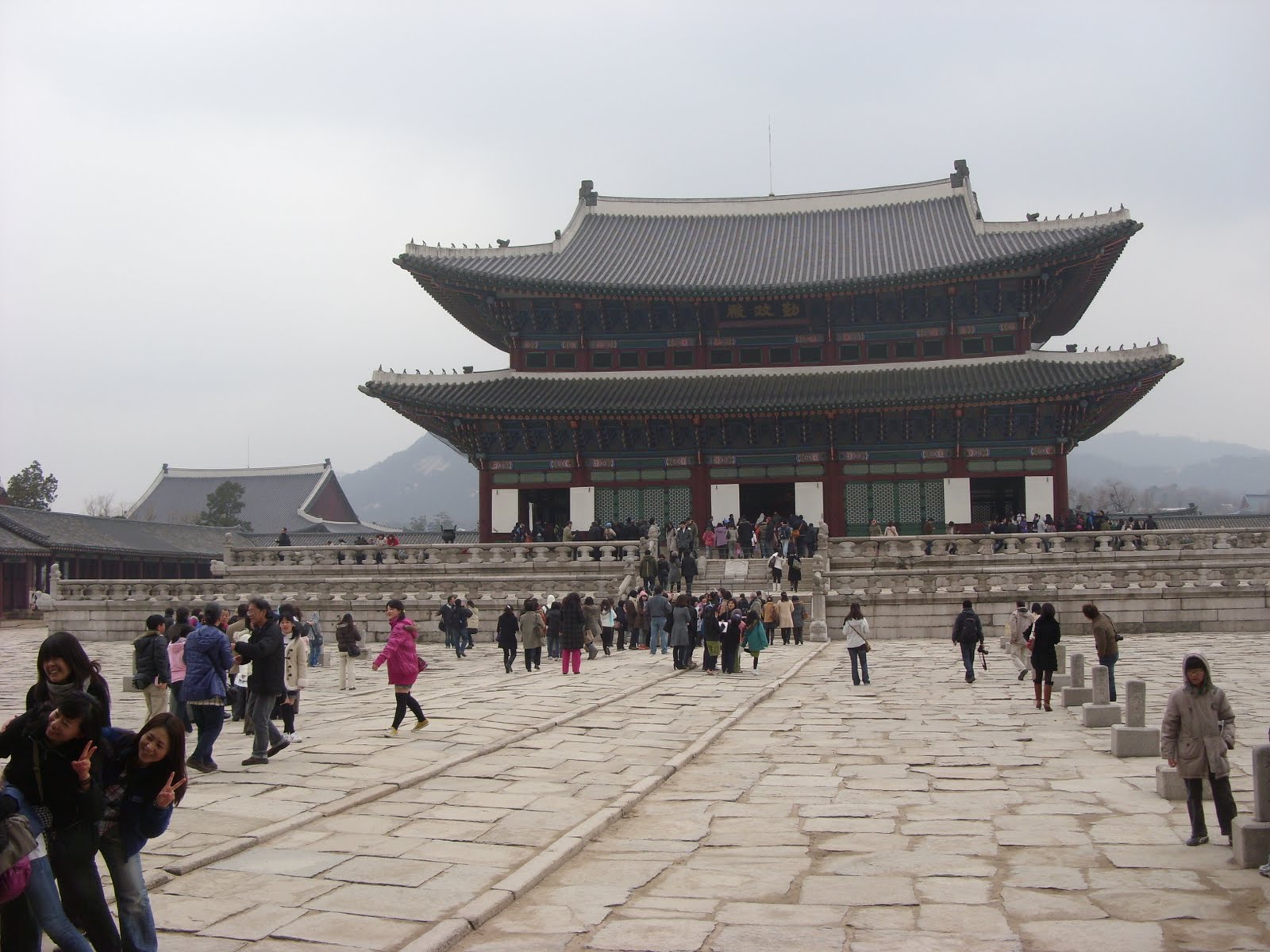
We just returned from the most delightful weekend trip visiting friends, Kurt and his wife J.Sun, in the soul (Yongsan) of Seoul. We made the trip on the KTX bullet train that speeds cross-country in less than two hours.  Here are a few photo's from our travels.
Geunjeongjeon at Gyeongbokgung Palace

A Gapsa Guard protecting the Palace Gate

The King's Throne in Geunjeongjeon

On the steps in front of Jibokjae (a reception hall for foreign envoys).

A study within Cheonchujeon next to Sajeongjeon -- "Hall where the king should thnk deeply before deciding what is right or wrong."
Mr. Park, a gentleman who volunteered to serve as our guide throughout the grounds of Gyeongbokgung.

Changing of the Gate Guard Ceremony

The viewof Seoul from Kurt & J.Sun's apartment on the 22nd floor of their building.

J.Sun, Sandy and Kurt in the gardens outside the Dragon Hill Lodge on Yongsan Base. Kurt is a Captain in the U.S. Army and the son of good friends from back in St. Louis.
Korean War Memorial Museum

Sunday afternoon shopping along the streets in the heart of Seoul.

23 March 2010

A Sunny Day at Sunrise Park

We hesitated to step out of our apartment Saturday morning.  It was too good to be true.  The morning skies looked sunny. The temperature might actually have risen. After just a bit of hesitation, we ventured out. Our weak faith in Pohang's March weather was strengthened!  Yes!  Yes!  It is truly warm. There's not a trace of clouds in the sky. Those are birds we hear singing out their calls.  That is a fragrance of cherry blossoms in the air!  Let's pack a picnic and head out to the bus stop.  We're on our way to the park!

For those of you who know St. Louis, you know that Forest Park is the crown jewel of the many public parks spread throughout both city and county.  For Pohang, Sunrise Park is their Forest Park. It is situated on the eastern side of the city along the natural bay that makes Pohang one of the principal port cities of Korea.  A short 15-minute bus ride from Handong's campus brings us to the southeastern entrance of Sunrise Park.
Across the street from the park rises a series of apartment towers forming one of the many typical housings complexes found throughout the city of Pohang. If you visit nearly any sizeable city in Korea, you will see similar apartment buildings. There are countless numbers of them.
Under a beautiful blue sky, we enjoyed a wonderful walk up the hillsides and through the park's gardens with their lovely arrangements of enormous granite rocks, both hardwood and fruit trees as well as shrubberies and flowers.  The trees are just starting to bud and the flowers are almost in bloom.  The warm sunshine and the calm sea breezes made for delightful temperatures through the morning and into the early afternoon.
Sandy and I enjoyed our picnic lunch on the steps of the amphitheater that overlooks the sea, and then, having been recharged, we ventured back along the trials up and over the hills toward the new museum of steelworks that will shortly be opening. (Did I mention in previous posts that Pohang is the steel capital of Korea?  Pohang is to Korea what Pittsburg is to the U.S. and what Sheffield and Birmingham are to England.)
After a quick bit of shopping at the local Lee Plus (like your neighborhood Walgreens without the pharmacy), we hopped on the next Handong bus back to campus and enjoyed a well-earned late afternoon nap.  Our delightful day at Sunrise Park convinced us that Pohang truly is a sunny place!

18 March 2010

How Do You Bear It???

I frequently hear this question from both students and fellow faculty members alike when I inform them that Sandy and I are living in a studio apartment within the campus Mission House. Their questions reflect the common knowledge that the Mission House studio apartments were originally designed for short-term occupancy by a single individual -- not extended living for a couple. How do you bear living in such close-quarters?

I also hear the same question -- So, how do you bear it? -- from friends and family, when they ask about our adjusting to life in a culture that is in so many ways "upside-down" from what a modern American is use to in this day and age. Not that we are experiencing "primitive living" in any way, shape or form -- our son Caleb would quickly attest to the many "modern" conveniences (like electric power and gas heat) that we daily are dependent upon -- but many of the "customary" life practices here leave us feeling very "foreign."

One experience this past week brought this question to mind in a particular manner. I was invited as a member of the undergraduate law faculty to attend the law student association's "MT" -- "membership training" session. I was informed that a bus would be provided to transport everyone from campus to a dining facility off-campus where we would enjoy a meal followed by the MT session. The bus was to depart campus at 6:30pm on Friday and, I was told, would not return until 2am.

What did you just say? 2am? I heard correctly, for such are the "bonding" experiences of students here -- which, if I think about it for a few minutes, is not unlike the late night excursions of university students in the States or in whatever country, for that matter -- but, did they really want their professors to hang-out with them? Well, . . . yeah. I was even treated to a seven course meal, prepared by the leaders of the student association, no less.

And then, we were all directed to a fellowship hall on a lower level of the building where a worship service was held. Prof. Chi, the chairman of the School of Law, presented a challenging message from the story of Micaiah, the prophet who spoke truth to power even though all the other 400 prophets affirmed the evil King Ahab’s plan. He reminded us that “bearing witness to the truth” in our efforts to “do justice” may often prove costly in our careers and even to our lives.

I was reminded by Prof. Chi’s words of what Jesus had said to his disciples: “For truly, I say to you, whoever gives you a cup of water to drink because you bear the name of Christ, will by no means lose his reward.” (Mark 9:41, emphasis added). Now the question came to me in a much different way – How do you bear it? That is, how do I bear the name of Christ? Do I bear it well, or do I bear it poorly?

That I “bear it” at all is only by the gift of God’s abundant grace. But, I would do well to examine myself regularly with this question. If I claim to be a Christ-follower, how am I doing bearing his name? Interestingly, the first followers of The Way (Acts 9:2) did not take on the name “Christian” (literally “little Christ’s”). Rather, they were called Christians in the town of Antioch. (Acts 11:26) Others recognized that they were following the life and teachings of Jesus Christ and so called them by his name. Is that how I have come to bear his name?

How am I bearing it, today?

ps – I didn’t end-up staying at the MT until 2am. One of my good and faithful colleagues, Prof. Cheoljoon Chang, graciously offered me a ride back to campus around 11pm. I have already found that when one has to bear with sleeplessness, it is an even greater challenge to bear the name. The spirit is indeed willing, but the flesh is weak.